Showing posts with label race fueling. Show all posts

Jana's Rev3 Race report - coach perspective - part 2

After providing some general training information for Jana’s program on part #1, now I dive into what was the more specific prep for Rev3 Quassy Half Iron distance, how we set up her tapering scheme and how we set up her fueling plan.

When preparing racing and fueling plans for my athletes I based all the information on what they have done in training and what we have practiced fueling wise. Using devices like a power meter and a GPS/pedometer for collecting data allows me to not only do performance modeling, but also produce racing execution plans.

That is, I use the data collected (training rides, testing, races) and based on that I can estimate when I can expect for each to hit peak performance and when I need to start the tapering based on their current fitness per sport (as opposed to following some arbitrary general taper plan, a common practice by many). With that in mind and based on the experience from coaching Jana for a bit less than  year before Rev3, I knew she didn’t need more than a week roughly to bring her fatigue curve down while maintaining her fitness high and the offset of fitness minus fatigue will result in a peak in performance.

Since Jana raced the American Zofingen (Tough duathlon with 5 miles run, 29 mile bike, 5 mile run, 29 mile bike, 5 mile run) with  3 weeks prior Rev3, she had a big build up for that which also became part of the peak training during her specific phase as I intended in her season planner. That means Jana had 6 weeks of intense training before Rev3; I set up her build up with ~12 hrs of training per week with almost 60% of that done at intensities of tempo (30%), threshold (20%) and VO2max (5%) for cycling, 55% of tempo, threshold and VO2max for swimming, and around 50% for running. After that it was followed by a ~6 day taper reducing training load broke down as 6 days for running, 5 for cycling and 4 for swimming.

After Zofingen, she had an unload week (low training load) before having a last intense 12+ hr training load week (similar load break down as before Zofingen) and for Rev3, the taper was actually a bit shorter (5 days) broke down as 5 days for running, 4 for cycling and 3 for swimming. This decision was possible thanks to the data collected on her training and knowing the recovery rate Jana has for each sport.

Once the taper plan was settled, the next step was to tweak her fueling plan which she has trained with pretty much since Clearwater 70.3 and something we have just polish ever since.  Based on her power data Jana needs ~1650-1750 Kilojoules (kJ) to cover 56 miles at the same constant body weight (which oscillates between 127-128 pounds). Knowing that, the variable will be how fast or not she will cover that distance which will change a bit her reliance on carbohydrates vs. fats (the more intense you race, the more carbs you’ll need in general).

I won’t go into the details as to how I produce the carbohydrates needs for my athletes in their racing plans as I don’t want to give away the calculator I created, but it is not something I developed nor secretive. It is available out there in books, studies and the web for anyone curious enough to find out and with some excel skills to produce! You basically need to know the kJ, critical power (CP), race intensity (% of CP), current weight, an educated guess on efficiency and every day diet (food Kcal intake based on %s of carbs:protein:fat), we know she needs ~70 grams of carbohydrates per hour. This correlates well with what current evidence suggesting how athletes can absorb around 1-1.5 grams of crabs per minute or 60-90 gr of crabs per hour.

Using pace plus the info suggested above you can also estimate how much you might need for swimming and running (though the latter is trickier). For Jana based on her weight, race pace (intensity), distance, every day diet, the fueling consumed per hour when biking, and the fact it is a bit more difficult in general to digest fuel when running,  she can handle ~40-45 gr of carbs per hour. In terms of triathlons, we fuel before the race hence we have enough to get through the swim portion, for that reason, for anything shorter than an IM, I am not too concerned at determining in detail fueling needs for this leg.

Jana (like many of my athletes) likes to train and race with Powerbar products because those don’t upset her stomach and it is what you find in many races nowadays. We also like the fact Powerbar peform has their C2max blend which means having two sources of carbs allowing a better/faster absorption in our body. This might sound as a promotional ad, but their C2max blend is actually supported by current evidence suggesting that sugars like glucose, maltose and maltodextrin can be absorbed faster when exercising, and while fructose is absorbed slower, a mix of something like maltodextrin and fructose will allow faster/more absorption as the body uses two different pathways (‘doors’) to absorb it.

Also, Powerbar products make it simple for my athletes to determine their fueling needs based on our plans because they clearly indicate the nutrition fact per serving but also, they advise mixing directions which another key element when considering a fueling plan. If you don’t have an optimal carbohydrate concentration of your sport drink (carbs vs ounces of water) you might risk, GI distress or even something like side stitches (transient abdominal pain) which evidence suggest might be related with the consumption of hypertonic drinks (high carb concentration). Most powerbar products used a 9% carb concentration, which falls within the 6-9% suggested in current research.

Considering all of the above, you can see Jana’s fueling plan below that she has trained with on most of her long rides and/or race rehearsals and also what she used for Rev3. She made some adjustments on the go with water but for most part, the fueling aspect of her races is almost automatic. This means, she doesn’t have to worry much on fuel details, she already has trained this and when racing is a matter of executing and focusing more on the pacing portion.


As you can see the plan above (which is included in all of our One-on-One coaching programs or available as a separate service through our fueling plans) is very detailed and make it simple for the athlete to know how much and when they will need fuel. We always make some adjustments based on every race and weather conditions and the plan is a flexible guide that we tweak as need it.  

Many of my athletes and myself like Powerbar products because of their quality and the way they make it simple to use taking the guessing out of the equation. For full disclosure I am sponsored by them through the Boston Triathlon Tea, still, after trying many products over the years I still like PB better.  At the end of the day, there are many quality products out there so go with whatever works for you!

On part 3 (and last) well talk about pacing and execution. Stay tunned…

Jana's Rev3 Race report - coach perspective - part 1

Last June 5, 2001 took place the Half Ironman distance race Rev3 Quassy; one of the fastest growing racing series and Revolution 3 is quickly earning a spot among the top triathlon production companies in the country. (good news for us triathletes!). The event also offers an Olympic distance race the day before and both take place at the Quassy amusement park in Middlebury CT which makes it an ideal venue for families as well as earning a reputation of one of the toughest races in the Northeast with a hilly bike AND run course.

Many E3 athletes participated either at the Olympic and Half Ironman distance and all enjoyed very much the event, the challenge and they achieved great results with podiums and personal records. Given Jana Richtrova (aka the Czech Chick) was the athlete I've been working with the longest and the one I have more data compiled, I decided to do a simple race report from a coach's perspective.

I hope this help you illustrate some of the preparation considered for each of our athletes, present you some of the many features our programs include and teach some of the things each of you should consider for your next race.

Let's start with a quick training summary: I've been working with Jana for a little less than a year now, last year she had a solid racing season with podiums and PRs at the Olympic and Half Ironman distance ending with her trip to the 70.3 World Championship in Clearwater, FL. The focus last year was to improve her fitness as much as possible while already in the middle of the racing season. This made challenging to address her weaknesses (her swim primarily, run secondarily) which forced us to focus on her strengths (cycling).

For this year, the focus changed to address her weaknesses while consolidating her strengths in the early part and later focusing on race specific fitness. Is no secret that her swim speed has been her Achilles heel ever since we began working together and we have taking a long term approach to improve it. We have seeing speed gains already but now we have to make those a reality in race conditions (open water). Rev3 posed a challenge as due to the nature of the weather in New England early in the year, Jana didn't have much opportunity to do open water swims and it showed in the race (more on this later).

Nevertheless Jana's Critical Swim Speed (CSS = the maximal speed she could sustain for roughly 3000 mts swim) has improved from 1:58 min/100 yds to 1:40 min/100 yds in 8 months. I actually think her CSS is faster but we'll confirm that in a coming test soon. Even though the Rev3 swim time didn't showed any improvements, I am certain was due to lack of open water swim practice and skills and for RI 70.3 things will be better. Still, it is important that her CSS is improving and you'll see why below when talking about critical power and critical velocity, not to mention the other benefits it might have provided, even when the swim time didn't reflected it.

In terms of cycling, her fitness which was good to solid to begin with has really improved at a very satisfying rate and has set her apart from her competition. Over the past 6 months post 'off-season', Jana's Critical Power ( CP = the maximal power she could sustain for roughly 1 hr) increased over 12% to roughly 240watts, all while riding less than 2/3 of what she rode the previous year.

I mentioned this to illustrate a point (and to poke a bit of fun to the base training crowd). Training gains are a function of training load which equals to volume plus intensity. To only focus on volume is to only address half of the training load equation. In addition, each athlete has particular needs and limitations, for the majority of the athletes I coach with other life priorities (work, family, social, etc.) the biggest limitation is time available for training/recovery.

I wish all my athletes had the luxury of having 20+ hours for training every week and still be able to be productive on other phases of their lives. But that is usually the exception, hence peak training weeks happen sporadically through a periodirized season plan. In Jana's case, time availability is a limitation, that plus her need to focus extra time on her swim and run fitness limited her time available for bike training.

Since I made her a convert to training with power when we began working together, it allowed me to have a lot of data from 2010 and helped us to manage her load more efficiently. Since riding hours and mind numbing miles at steady pace (base training) was not an option, we focused on endurance, race specificity AND intensity, all mixed together week after week. This allowed her to maximize her time and fitness gains with almost half of the total volume she did a year before.

Jana's power distribution Jan-May 2011
AR = active recovery, E = endurance, TE = tempo,
TH = threshold, VM = VO2 max, AC = anaerobic capacity
For comparison, from Jan to May 2010, Jana rode ~1900 miles mostly as 'base training' before we worked together. For the same time frame on 2011 she rode ~1250 miles, mostly with a variety of intensities though with emphasis on her CP. Also most of her riding was on the trainer on 2011 vs 2010 due to time limitations.

Still, I wish I would have data from her intensity from 2010 because I can guarantee her intensity (completing the training load) was a lot higher in 2011.

For reference, on the chart above you can see how out of all the miles Jana has rode on 2011, most of her time has been spent on Tempo pace (80-90% of CP) which is race specific for a half iron distance and she spent almost as much training at her threshold and VO2 max than at her endurance ('base building') -- check her 2010 data here -- and 2011 data here --

This methodical approach yield Jana great critical power improvement, it allowed her to increase her power to weight ratio to 4.11 w/kg, which means for every kilogram of body weight she can produce ~4.1 watts. This is up there with some of the strong cyclists in triathlon races including male athletes!

But how is it possible that Jana improved her critical power without doing much "base training"? Better yet, how is possible that Jana increased her CP and endurance at the same time? It is simple, it was because she is a great athlete, she works very hard and because together we formulated a plan addressing her own needs. There was no trying to fit her into a one-size fits all plan, there was not forcing her to match my coaching beliefs and certainly there was no forcing her to mold into any kind of 'system'.

That and of course understanding why improving one's critical power should be a focus for any endurance athlete. To illustrate this see the graph on the left. It shows how her CP increased to around 240w on 2011 (from ~210w on 2010).

Considering most athletes will race a half iron distance between 80-85% of their CP, it is easy to see why Jana's mixed training allowed her to go faster with seemingly less volume (which is not to say less training load). In other words, riding at the same intensity (80% of her CP) for a half iron distance allowed her to race around 20 watts higher than last year simply by having a higher CP and doing the adequate training!

In terms of running, while Jana's running is solid vs some of her competitors, in terms of her goals (winning races overall) it is a 'weakness'. Hence, we have been proactively addressing and making it also a priority within the context of the entire program. 6 months ago Jana's Critical Velocity (CV =  the maximal velocity she could sustain for roughly a 10 Km) was around 7:02 min/mile and just before Rev3, her CV improved around 6:40s. Same as CP, CV is one of the most important markers for endurance athletes; if you improve it, you will be able to race faster at the same sub-maximal effort level. That is, if last year she was able to race around 90% of her CV for a half iron (~7:35 min/mile), this year, on a flattish course, she should be able to do around ~7:15s min/mile. (I guess will find out at RI 70.3!).

That said, her training progression has been different given her specific needs. Prior we started working together, Jana was battling some hip/leg injuries hence all last year the goal was to address this minor injuries and then get her fit without placing too much strain risking re-injuring it and managing the ongoing racing season. Earlier this year, the goal was to set up a foundation to allow her to increase the training load via volume and frequency with some specific intensity. At the same time we focus on a strengthening program to make sure no other imbalances will result in overuse injuries as the load increased.

This has allowed her to increased her CV without injury set backs (knock on wood), and now, we can focus on maximizing her CV which will be the focus for the coming months.

Now, that I set up the stage about Jana's training program and fitness progression, on part 2 I'll dig into her racing plan, compared it to her execution (sharing power/pace data) and will share her fueling plan before, during and after the race. Stay tuned...

Alaina's Triple-T Race Report

By Alaina Neary Case

Quick Recap:
This race is just awesome. Everyone should do it at least once in their triathlon career. The course is hard, but gives you a great sense of accomplishment at the end of the weekend. I paced everything just right, and if it weren’t for the heat on the half-ironman run, we would’ve crushed our time from last year by even more. As it stands, as a team, we beat last year’s time by over 15 minutes and won the Co-Ed division again. First race of the year was a win!

The American TTT is a unique event that is a must-do for every triathlete. The race is a 3-day, 4 race event in the gorgeous foothills of Southern Ohio, in Shawnee State Park. Over the course of the weekend, racers complete almost 146 miles of racing on a very challenging course.

Michigan has been dealt some particularly nasty weather this spring, and I’ve only been outside on my tri bike about 10 times, and hadn’t been able to swim in the open water yet. All of the rain and cold just made this event seem even more surreal- like doing a triathlon in Mid-December. My fitness was spot on, though, and I’ve made some gains since last season. My husband and I were racing as a team again, and this year, the pressure was on. We were the reigning Co-Ed champs and the targets on our backs were flashing neon.

Race 1: Super Sprint- 250yard swim(53rd), 5 mile bike(86th), 1 mile run(39th)- Total Time: 24:15. 62nd Overall, 2nd Female

Before the gun goes off at 5:00pm, Ryan and I donned our wetsuits and swam the course in the frigid 58F water. I LOVE my De Soto T1 wetsuit- it kept my body magically afloat, propelled me like a motor and kept all the cold away from my body. Only my face and feet let me know just how chilly that water was. Now that my first open water swim of the season was done, it was time to race. This super sprint is so short and sweet that it sets you up perfectly for the weekend. You get the kinks out, practice your transitions, but don't need to get all nervous or worked up for a hard race. 

The swim was over almost as soon as I started, and I got of the water in just under 5 minutes. Transition is slow, as per usual, but it was worse for me because my wetsuit got stuck. The bike course starts downhill, then has you climb 2 very steep miles till you turn around and come screaming back to T2. My Garmin battery had died on the car ride to Ohio, so I just went off feel- stay right under threshold. No problem. I just needed to add 2 10lb rocks to my bike to keep up with all the big boys on the downhill!! Also, I am always surprised at how much people go over what must be their threshold on the uphill portions. Now that I’ve learned a great deal from Coach Jorge, I know how silly it is to burn your legs up on the hills, and even without my PT numbers, I could pace myself just right to not do any damage.

T2 was a breeze. I’m at the point where I’ve done this so many times now that even though I haven’t had any practice so far this year, my years of experience make this easy and stress-free.

The run is a quick out and back, and I took the pace hard, but didn’t max out my lungs. It felt like I passed a ton of people and my legs were SO happy to be racing- nice and rested and ready to fire. It was over so quickly, but it got me fired up and excited for the rest of the weekend, as well as for the rest of the season!

Race 2: Olympic, Saturday AM, Individual, regular format
Swim: 21:06 (71st), Bike: 1:17(86th), Run: 45:32 (44th) Total Time: 2:26:20 (56th)

There are so many things that went well this weekend, but one of the issues that I’ve been struggling the most with is staying calm, mentally, and not getting myself all worked up over the race. Since this event is so chill, and so long, I got to practice staying calm and having a lot more FUN during each race.
Transition was a quick set up and everyone at the race was in a great mood. After a quick dip in the lake, I was ready to go! On the swim, I stayed in my zone and tried to push it, but the entire race, I kept repeating ‘half-ironman, half-ironman’ to remind myself that this entire weekend comes down to tomorrow’s run. For having no OWS practice, my sighting was dead on, and the whole swim was really enjoyable. I seriously can’t mention enough how much I love my wetsuit!! 

Transition was slow, but that’s the small price I pay for having to take off the 2-piece suit. If I actually practiced this, I would improve...but that would require work ;)
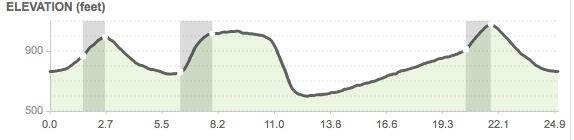
The bike course this year was different from last year due to weather interference, so this year, we got to climb the infamous ‘Thompson Hill’ and descend on ‘Little Itch Road’. The RD gave us tons of warnings about changing our gear before the climb, and BRAKING for the descent- they had an ambulance waiting at the bottom of the hill, it was that serious. On the bike, I just watched my power, and was amazed how easy 190watts felt. Climbing the hills felt SO much easier than last year, too, and I could turn over my pedals without spiking past threshold- something that seemed nearly impossible last year. Well, I had to spike my power at Thompson Hill, since it starts off at 22% grade, and averages 18% grade for the half mile (or so) climb!! After all that climbing, the descent wasn’t even worth it, it was so insane-HA! I had to brake SO hard that my hands hurt. The road turned to crap, the turns were 180 and the path was pitched with holes. Wow, it was almost easier to climb than it was to descend this little ‘itch’. If i were a braver rider, i could've gained back m ore time, but my cautious nature really slowed me down on the bike. 

The run course for the entire weekend is a 6.55 trail run that is all dirt, rocks and ruts, with horseflies, hills and snakes to keep you interested. Luckily, almost the whole trail is shaded. I took off for the run feeling excellent, but also knowing that I wasn’t even close to half way done for the weekend. I only paid attention to my mile by mile splits, taking the uphills steady and flying down the downhills. The course is uphill for the first 3 miles, than down a big hill to the turn around. Coming back up sucks, but once you hit mile 4, you get to just FLY back to the finish. It’s a fun run, and I am very happy with this pace because it really felt like I was just on cruise control. While I was headed up the trail, Ryan was flying back towards the finish, at least a mile ahead of me. He was just speeding along, and I was incredibly impressed with how far ahead of me he was.
After I crossed the finish line, I felt great. I was happy with my time, and knew that the race had felt ‘easy’, which was good, since we still had a long way to go. I went straight over to the icebath creek and soaked my legs. I chatted with the female leader, former pro triathlete Paolina Allan. I made sure she wasn’t on a co-ed team, and she made sure I wasn’t gunning for top OA female- and then we were friends :). Even though I still wanted to be first place female, it doesn’t really count, since I am on a team and can draft on the bike course.
Bike Course:


Race 3: Olympic, Saturday PM, Team- Format: Bike-Swim-Run
Bike: 1:14:48 (51st) Swim: 22:35 (35th), Run: 49:27(34th) Total Time: 2:31:48 (37th)

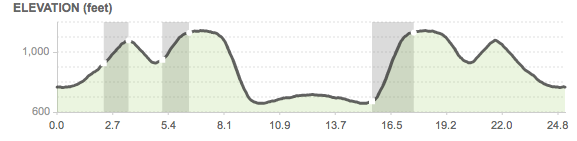
The third race is funny, because you start off on the bike, then you swim, then run. It’s also different because now Ryan and I could race as a team. This race is also on Saturday, about 6 hours after we finished the first race. In between races, I ate as much as I could, and took a brief nap at a friend’s hotel. When we started, I wasn’t really feeling very perky, but luckily, Ryan was, so he pulled me along on the bike course. Funny thing, though, even though I was drafting behind him, my power numbers were almost the same as when I was on my own! This course was an out and back, with 2 major climbs. I pulled on the climbs, but Ryan did most of the work on this ride. My average power was only 12 watts lower than the morning, though!

We got back to transition in what seemed like the blink of an eye, and I was finally feeling better about racing. It took me quite a while to get my wetsuit on, so Ryan just left for the water, since I’m a faster swimmer anyways. Putting on your wetsuit, while in a hurry and all sweaty just isn’t fun. Depsite that, I still had a good swim- only 1 minute slower than the morning’s swim. The key to this swim is to not use your legs at all, because if you kick, you risk cramping. So, even without kicking I managed a great swim, and still had to wait over a minute for Ryan in transition. No big deal, I like slow transitions! When Ryan got in, I was ready to run and we took off for another tour of Lamp Black trail. Although we were both feeling good, we held back a ton because we knew just how tough tomorrow’s race was going to be, and we also knew that slowing down on this run is key to having a good Sunday race. We wanted to hit 7:30s and we that pace on the nose. We felt terrific at the end, took a dip in the creek and headed back to the hotel to eat and rest for tomorrow’s HIM! We were finally half way through the weekend!
Bike Course:

Race 4: Half-Ironman, Sunday AM, Team-Format: Swim-Bike-Run
Swim: 31:07 (68th), Bike: 3:03 (40th), Run: 1:48:10 (34th) Total Time: 5:26:14 (36th)

Last year, Sunday morning was one of the most brutal mornings all season. I was completely sore and miserable, and had absolutely no desire to race a Half-Ironman. This year, I can’t say I was ‘excited’ to race, but I wasn’t stiff, I wasn’t fatigued, and I generally just felt good! I knew that I paced the races on Saturday just right, and today wasn’t going to be as awful as last year. When we got to the race site, we checked the team results, and found out we were at least 15minutes ahead of the 2nd place team- if not more (they list the results kinda weird). AWESOME! We were already faster on all the races, so barring any major disaster, this race was ours. This was a huge relief, because at this point last year, we were only a few minutes ahead of our rivals, and had a lot of pressure going into the half.

Walking down to the beach on Sunday morning is a death march- someone described it as a zombie walk. The race is supposed to start at 7:00am, but virtually everyone was still in transition. If we don’t line up, the race can’t start, dangit!! Ryan and I again started together, but since I’m the stronger swimmer, I took the swim pretty easy. I don’t exactly have an ‘easy’ gear to swim in, but I really focused on not expending a lot of effort. I can’t even tell you how happy I am with how I swam- none of my efforts were too taxing, my sighting was nearly perfect, I took the course as short as possible and managed to have hardly any contact with any swimmers. Rather than take any credit, I will say that all of those good things happen because of my wetsuit- even the sighting :) I walked up to transition, and was dreaming of eating a pop tart while waiting for Ryan. I put my bike stuff on, just in case, before eating that poptart, then all of a sudden- there he is!! Omigod, he swam so FAST! No poptart for me- gotta race! So we ran outta there and hopped on our bikes for one last tour of Shawnee state park.

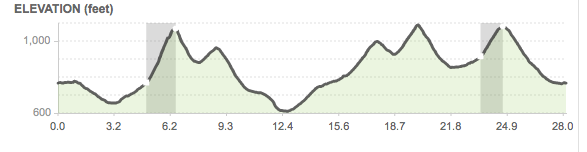
This bike ride is my favorite. It is harder than both of the other courses, because there are steep, hard climbs as well as longer sustained climbs, but the scenery and roads are just so friggin’ cool. I wish I could take this park home with me, and ride it every weekend. I was feeling great today, so I pulled just as much as Ryan on this course. I would tend to pull a bit more on the climbs, because I’m better at not spiking my watts, and get more of an advantage off of Ryan on the downhills and flats, than he does off of me. It really felt like we had a strategy, and worked perfectly as a team. We stopped briefly to pee after completing one loop, and it was just great that we felt so much better than last year. We took over 6 minutes off of our time, felt a ton better and averaged lower watts.

Once the bike was done, we could tell how hot it had gotten-it was going to be the hottest day of the year, by a long shot. We’d only trained in temps above 75 maybe twice all season, and today it was going to hit over 85 (and humid, of course). At the start of the run, Ryan said he wanted to do 8’s to start with, and possibly pick up the pace on the second lap. I was fine with that, and within 2 miles, we passed our rival team. They had always been ahead of us off the bike, but we had already outrun them once, so we were pretty confident we had passed them for good this time. That was a huge relief, because it meant we were DEFINITELY going to win first place Co-Ed team. Now it was just a matter of not blowing up and doing something catastrophically stupid. 

As we kept plugging along, it was obvious that Ryan was in a bit more distress than I was. He was overheating and his chest and lungs were not handling the heat very well. We already both know that he needs about 2 weeks to acclimate to heat, and that just wasn’t possible this year, so we had to manage this issue by slowing down whenever he was feeling panicky. This is where the good and bad of being on a team happens- when one of you feels like shit and the other isn’t- how does the team handle this- especially a married team! Luckily, we handled it perfectly. The one thing I could do was calm Ryan down with my words, and work hard on not pushing our pace and paying attention to his signs of distress. I also made sure to let him know that walking didn’t matter, because we were already winning and it wasn’t worth killing ourselves at this point to run hard- there just wasn’t a point! So we ran as much as we could, but walked a few of the hills. I helped instruct Ryan to eat and drink and dump ice down his pants, and it all seemed to help. By focusing on him, I didn’t feel much of anything on this run, and was very happy that my breathing and stomach all felt excellent- something that hasn’t happened during a race in a long time. Despite being slower on the run last year, our overall time was faster, and we had a much better time during the race, even with the heat.

Bike Course (x2):
After the final race, we cheered on our friends, chatted with new friends and ate some more food. It felt great to know we won, for the second year- both of those $1500 gift certificates were OURS! A huge shout out and thank you to Jorge at E3 Training Solutions for all of your amazing coaching, and helping both Ryan and I with a plan to win for the weekend. I seriously owe any successful race to your careful preparation and confidence in my ability. Thank you Jorge!

E3TS Simple Tapering, Fueling and Pacing Guide for a Marathon

As the Boston Marathon approaches, I've been doing different talks for the Run For Research marathon team, the Team in Training and the City Sports Running Club (sponsored by Nike) to help athletes with the final preparations for the big day.

The main topics I've been presenting have been tapering, nutrition leading up to the race, fueling during the race and simple pacing strategies. Because of that, I decided to compile the information I've presented and put together our own E3TS Simple tapering, fueling and pacing guide for a marathon. Since this talks target a wide range of runners and specific to the Boston marathon I kept the information simple and general.

Still, the guide will be helpful for any runner and distance as the guide provides science supported and proven concepts. For more specific information, you can get more info on our simple guides section where you will get a wide range for training topics. For coaching, training plans or nutrition/fueling information please contact us at jorge@e3ts.com

Don't forget to follow us on our Twitter Account or Facebook Page for Boston Marathon race day updates, pictures and other live commentary from the starting line, mile 15 and the finish line.

E3 Run/Cycling Fueling Plans

Single Race Specific Fueling Plans - $49 (running)
Multiple Race Specific Fueling Plans (up to 3 race distances) - $99 (running)

A personalized plan is developed based on the athlete’s specific needs, goals, fitness level, gender, age and weight for the week leading up to the main race, the morning of the race, during the race (break down by each sport) and for after the race. This will take the guessing out of your training and allow you to avoid fueling issues during your races; don’t let all your hard work and training go to waste due to fueling mistakes on race day!

Through a particular fitness and fueling questionnaire assessment, we’ll develop the optimal fueling plan that will help you achieve peak performance.

The Fueling Plan Includes:
  • Initial Fitness Assessment & Fueling Questionnaire
  • Race fueling plan break down for fueling before the race, during the race and after the race including carbohydrate/protein, hydration and electrolytes recommended intake race specific for up to 3 different race distances (i.e. fuel plan 10k, Half-marathon and Marathon or Time Trial, Century and Stage Race)
  • Plan includes recommendations for fueling needs during taper week leading up to the race.
  • Face-to-face or conference call consultation to discuss the details for the fueling plan and address specific questions.
  • Follow up to tweak plan to accommodate the athlete’s specific needs after the athlete test it during training sessions and race simulations. (i.e. long runs)
Run Race Specific Fueling Plan

--- This is including on our one-on-one programs and available at discounted prices for our Performance Plans & YouCoach services ---

APPLY NOW Click Here


Run Plans


E3 Triathlon Fueling Plans


Single Race Specific Execution Plans - $99
Multiple Race Specific Execution Plans (3 different race distances) - $149

A personalized plan is developed based on the athlete’s specific needs, goals, fitness level, gender, age, weight and expected racing intensity. Training data like power files and/or GPS/HR from key training sessions are considered and analyzed to strike a balance between the athletes goals and current fitness level. This will take the guessing out of your racing execution and allow you to pacing mistakes during your races; don’t let all your hard work and training go to waste due to a pacing/execution mistake on race day!

Through a thorough training log and specific file analysis and the athlete's feedback, we’ll develop the optimal racing execution plan that will help you achieve peak performance.

The Racing Execution Plan Includes:
  • Training Log Assessment
  • Simple power, GPS/HR file anlaysis
  • Race execution plan break down per racing leg (swim, bike, run) with specific paces, power or heart rate zones.
  • Plan includes recommendations pacing ceilings depending on the specific course topography and expected weather conditions.
  • Face-to-face or conference call consultation to discuss the details for the racing execution plan and address specific questions.
  • Follow up to tweak plan to accommodate the athlete’s specific needs after testing it during race rehearsal.
Race Execution Sample Plan

Single Race Specific Fueling Plans - $99
Multiple Race Specific Fueling Plans (3 different race distances) - $149

A personalized plan is developed based on the athlete’s specific needs, goals, fitness level, gender, age and weight for the week leading up to the main race, the morning of the race, during the race (break down by each sport) and for after the race. This will take the guessing out of your training and allow you to avoid fueling issues during your races; don’t let all your hard work and training go to waste due to a fueling mistake on race day!

Through a particular fitness and fueling questionnaire assessment, and phone consultation, we’ll develop the optimal fueling plan that will help you achieve peak performance.

The Fueling Plan Includes:
  • Initial Fitness Assessment & Phone Consultation
  • Fueling Questionnaire
  • Fueling plan - fueling advice for before the race, during the race per sports and after the race including carbohydrate/protein, hydration and electrolytes recommended intake race specific for up to 3 different race distances (i.e. fuel plan for Olympic, 70.3 and Ironman distance or 10k, Half-marathon and Marathon)
  • Plan includes recommendations for fueling needs during taper week leading up to the race.
  • Face-to-face or conference call consultation to discuss the details for the fueling plan and address specific questions.
  • Follow up to tweak plan to accommodate the athlete’s specific needs after testing it during race rehearsals.
Triathlon Race Specific Fueling Plan Sample
Package - Single Race Execution And Fueling Plan - $149
Multiple Race Specific Fueling Plans (up to 3 race distances) - $200

The Racing Fueling Conundrum

Anyone who spends time in triathlon forums knows that the fueling topic is a recurrent theme from beginners to seasoned athletes. Common questions such as: how much fuel should I take, what kind of fuel, how many calories and what should I take before, during and after racing is something we hear over and over and over.

In addition, anytime time we read race reports or listen to the stories of our fellow athletes regarding a bad racing experience, invariably there are 3 main reasons their races went south: 1) poor fitness prior the event, 2) poor pacing during the race and/or 3) poor fueling execution.

This time I am going to focus on the last point though in most cases the reason why athletes struggle during a race can be the mix of all 3 points mentioned above.

Nowadays with so much information available (though not necessarily good one) found in magazines, books and websites it is easy for athletes to get confused as to what is the best fueling strategy for them to follow would be. Many try to emulate what professional athletes do or follow one size fits all suggestions; for that reason let me break it down for you, there is no one optimal fueling strategy that will work for everyone.


We all respond different to training/racing and we’ll have different fueling needs based on our fitness level, age, gender, racing distance, racing intensity, goals, diet, what our bodies can tolerate, etc. That said, there are certain basic rules that can help you out to identify what’s the best strategy for you and over time through testing it out through training you can indentify what works for you. But before getting into that, let’s get a quick simplified physiology lesson.

Body’s Fuel sources
Anytime we exercise our body requires converting fuel to energy (
ATP) depending on the duration and intensity of such exertion. The sources of fuel are carbohydrates, fat and protein that we all get through our regular daily diets. Carbohydrates and fats provide most of the energy we require when racing from a sprint to an Ironman while protein could be used but only on extreme cases such as in a depleted state though some studies have shown limited benefits from consuming branched-chain amino acids (BCAA) but still, the information available is inconclusive hence I won’t spend time discussing it in this article.

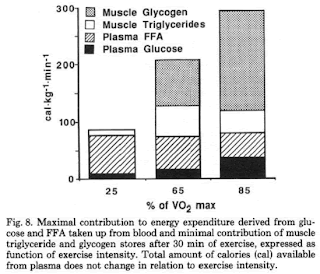
Since both carbohydrates and fat fuel us, we need to consider both as important though our body uses them differently depending on how hard and/or long we are working at a given time. In general fat provides a greater percentage of fuel for energy at lower intensities while carbohydrates provide a greater percentage at higher intensities. Around 65% of VO2 max or 75% of threshold our bodies roughly use around the same ratio. The table below illustrates this rather well:


The key point to remember is that both fat and carbohydrates contribute to fuel our races and even at lower intensities carbohydrates play an important role! Our body have a limited storage capacity for carbohydrates (store as glycogen) while we have ‘unlimited’ capacity for fat (not really but we store much more fat than carbohydrates) hence we need to place special attention on our carbs stores.

Depending on fitness, age, weight, etc. in general an athlete can store around ~500 grams of glycogen (~2000 Kcal) with roughly 400grams store in the muscles and the rest in the liver. Fat stores on the other hand are virtually unlimited, that is a 150 pound athlete with 10% body fat has 15 pounds available which is more than enough to get you through an Ironman.

The problem is that not matter how much fat you have available in your body, if you deplete your muscle glycogen you’ll be force to slow down. In addition, your brain requires a constant supply of glucose, if you deplete your liver glycogen you won’t be able to maintain an adequate blood sugar level and your body will shut down (“bonk”)

The take away message is that you need to replenish your carbohydrates fuel stores in order to avoid depletion and ultimate result in slowing down when training/racing.

How much fuel (carbohydrates) do I need when racing?
Here is where things can get a bit complicated because how much carbs you should consume when racing will vary based on:

  1. Your fitness level - metabolic fitter people are able to increase their carbohydrates storing capacity.
  2. Your intensity - depending of what % of your threshold power/pace you race at will vary how fast you go through your fuel tank).
  3. Other variables like temperature, topography, weight, age, gender, etc.
In general we want to keep things simple and mainly avoid fueling too little or two much hence with a power meter/GPS OR a few simple general rules and some trail and error when training, you can figure out your optimal fueling strategy. One thing we need to establish first is that roughly it will take you the same amount of work to go certain distance as long as you keep a constant weight.
For instance; if you have two athletes of the same weight and have them ride say 112 miles it will roughly cost them the same amount of energy (kilojoules – a mechanical measure of energy measured by a power meter) even though rider A might be able to complete the ride in 5 hrs while rider B in 6 hrs. The amount of energy needed was roughly the same; the difference is how quickly each of them covered the distance faster.

Knowing the above it would be safe to assume rider A was riding the course at a higher percentage of his/her power threshold (resulting in greater amount use of his glycogen storage) while B used less. What many AGers struggle with, is determining how much carbs/kcal they should ingest per hour and most over estimate it and end up experiencing gastro-intestinal distress. Many believe since they'll spend a longer time racing then they need more fuel!

To avoid this let’s compare rider A and B above and make some generalizations/assumptions to illustrate this point:

First let’s assume rider A rode at ~80% of his power threshold while rider B did at ~68% both requiring roughly ~3600 kilojoules (kJ) to cover the distance. We don’t use all our energy to propel our bikes as our bodies aren’t very inefficient at converting fuel for energy and some of it is lost as heat and through other physiological processes hence even though 1 Kilocalorie (Kcal) equal 4.186 kJ, since not every Kcal is use to propel our efforts, you can estimate your Kcal from a total ride kJ by multiplying your total kJ times 1.05 for very efficient athletes to 1.15 very inefficient.

A good enough guesstimate would be somewhere in the middle at 1.1; for the example above both athletes will need around 3960 Kcal to propel their efforts. But both riders didn’t start the ride depleted; assuming both optimally fueled prior the ride then both had at least 2000 Kcal or 500 grams (1 gr of carbs = 4 Kcal) at the start hence they need to supply only about 1960 Kcal during the ride.

Now, for rider A since he/she rode the course at 80% of power threshold then he/she needs to supply around ~1568 Kcal (80% of 1960 Kcal) or ~314 Kcal per hour (~78 grams of carbs) and the remainig ~400 Kcal will come from his/her fat storage which since it is ‘unlimited’ there is no need to supplement.

For rider B since 68% of his/her fueling demands will come from carbs then he/she needs 1333 Kcal or 222 Kcal per hour (55 grams of carbs) and the rest ~600 Kcal from fat. That’s around 100 Kcal per hour lower than ride A!

Of course the above doesn’t work exactly that way and I made generalizations/assumptions but i serves as a simple way to explain why even though many AGers spend more time on the course, since they'll racing at lower intensities they will need less fuel per hour even when they will endure a longer racing day. In general, their fueling needs will be lower since their fueling needs will be lower from carbohydrates and higher from fat than those racing less time but at higher intensities.

The take away message is that athletes have to develop fueling strategies based on their specific racing needs (fitness, intensity, duration, et.). If you have a power meter and a GPS you can use the information to estimate Kcal intake needs easier and use the data to determine fueling needs testing it in race rehearsals. In the absence of that you can use some of the simple general ‘rules’ below:

2-3 days before a big race:
  • Be particular proactive to consume carbohydrates (plus lean protein and good fat) to make sure your glycogen storage is full but use common sense; use good sources of carbohydrates (low glycemic index) and don't over do it.
Before racing:
  • 2-3 hrs before racing window; 1-2gr of Carbs x KgBW (Kg of body weight). The longer the race or the harder you’ll race consume upper end. Avoid consuming food with a high fat or fiber content to avoid GI issues.
  • 1 hr or less before training window - consume 15-24oz sports drink OR water plus gel per hour. If you did a good job fueling 2-3 hrs before you don’t need much, you just want to stay hydrated
During racing window*:

  • Sprint race; 0.5-0.7gr CHO x KgBW per hour - consume lower end if it will take you less than 90 min or higher end if over 90 min
  • Olympic race; 0.7-0.9gr CHO x KgBW - consume lower end if it will take you less than 2:30hrs or higher end if over 2:30 hrs
  • HIM race; 1-1.2gr CHO x KgBW - consume higher end if it will take you less than 5:30hrs or lower end if over 5:30 hrs
  • IM race: 1-1.3gr CHO x KgBW - consume higher end if it will take you less than 10:30hrs or lower end if over 10:30 hrs
Post training, 30 min window:

  • 0.5-1.1gr CHO plus 0.1-0.3gr of protein x KgBW depending on duration/intensity of session (goal - stabilize glucose levels in the liver, improve recovery processes, etc)
(*) - Females will probably need a bit less than males.
Using this information you can set a simple racing strategy and test it in your next long training day. Adjust it based on your specific needs and in no time you’ll know what you need to consume to fuel your training/racing; what’s best is that you’ll most likely realize this can be rather simple and affordable. I hope this helps you find the best fueling strategy for you!

* Evidence suggests our bodies can’t process/absorb more than 1-1.2 grams of carbs per minute hence most athletes won’t be able to handle more than 60-75gr of carbs (240-300 Kcal) per hour in general.

Want to learn more? Sources:
  1. Int J Sports Med 1980; 1:2-145. Sports Med 1992; 14: 27-42
  2. Metabolism 1996; 45:915-921
  3. Am J Physiol Endocrinol Metab 1999; 276: E672-E683
  4. Med Sci Sports Ex 1993; 25:42-51
  5. Int J Sports Med 1994; 15:122-125
  6. Horm Metab Res. Jan;40(1):24-8, 2008
  7. J Appl Physiol. Nov;105(5):1462-70, 2008
  8. Eberle S, Endurane Sports Nutrition, Human Kinetics, 2nd Ed, 2007.