Recovery is a vital component of any training program from recovery during a training session, between intervals and between training sessions. The training concept of stress/adaptation suggests that through training we induce a stress as a result of the training load we do (volume + intensity) and this forces our bodies to adapt.
The trick is to provide the right stimulus stressing our bodies withing our own limitations. That is, to do the right amount of load to force our bodies to produce a series of physiological adaptations that ultimately will increase our fitness, but managing this to avoid more of what our bodies can handle resulting in inadequate recovery.
Failure to adequately manage your load and allow your body to adapt can result indifferent scenarios:
1. From session to session this can result in excessive micro damage on our musculoskeletal system in the form of delayed onset of muscle soreness (DOMS) or high levels of creatine kinase (CK). This might force the athlete to reduce the load of the next session or delay/skip training making it inconsistent.
2. From a series of sessions, in addition to the above, it can also result in your body inability to restore your body's glycogen which you body oxidize to propel your training in addition to fat. Though when compared to fat storage, we have a limited captivity to store glycogen hence it is vital to replenish it.
3. Chronic fatigue - by constantly pushing your body beyond your own capabilities, athletes eventually can face big setbacks in the form of injuries.
In order to avoid the above, at PBM Coaching we have developed a simple approach to address this through the 3 Cs for recovery. It will give you an idea as to what strategies you can apply to enhance your recovery and improve your fitness, in addition to reminding you to always manage your training load wisely.http://urlm.in/gsib

Engage Your Inner Champion
Showing posts with label endurance sports. Show all posts
Showing posts with label endurance sports. Show all posts

PBM Coaching Newsletter Fall 2010
Check out our Fall 2010 Newsletter http://conta.cc/bHoyZ1 via #PBMCoaching
We still have opening for the 2011 Season. Call us today, we only coach a limited number of athletes every year. Don't miss out!
Simple Injury Prevention Tips
Most of you are either in the middle of the off-season or already starting programs for early season races. Here are some simple injury prevention tips that might help you get ahead of nagging injuries.
Keep in mind that doing just enough load (training) within your own limitations and fitness level is probably the most important determinant to avoid injuries, still, taking care of the details is what makes simple training into optimal training!
Simple Injury Prevention Tips PDF
Keep in mind that doing just enough load (training) within your own limitations and fitness level is probably the most important determinant to avoid injuries, still, taking care of the details is what makes simple training into optimal training!
Simple Injury Prevention Tips PDF

The Racing Fueling Conundrum
Anyone who spends time in triathlon forums knows that the fueling topic is a recurrent theme from beginners to seasoned athletes. Common questions such as: how much fuel should I take, what kind of fuel, how many calories and what should I take before, during and after racing is something we hear over and over and over.
In addition, anytime time we read race reports or listen to the stories of our fellow athletes regarding a bad racing experience, invariably there are 3 main reasons their races went south: 1) poor fitness prior the event, 2) poor pacing during the race and/or 3) poor fueling execution.
This time I am going to focus on the last point though in most cases the reason why athletes struggle during a race can be the mix of all 3 points mentioned above.
Nowadays with so much information available (though not necessarily good one) found in magazines, books and websites it is easy for athletes to get confused as to what is the best fueling strategy for them to follow would be. Many try to emulate what professional athletes do or follow one size fits all suggestions; for that reason let me break it down for you, there is no one optimal fueling strategy that will work for everyone.
We all respond different to training/racing and we’ll have different fueling needs based on our fitness level, age, gender, racing distance, racing intensity, goals, diet, what our bodies can tolerate, etc. That said, there are certain basic rules that can help you out to identify what’s the best strategy for you and over time through testing it out through training you can indentify what works for you. But before getting into that, let’s get a quick simplified physiology lesson.
Body’s Fuel sources
Anytime we exercise our body requires converting fuel to energy (ATP) depending on the duration and intensity of such exertion. The sources of fuel are carbohydrates, fat and protein that we all get through our regular daily diets. Carbohydrates and fats provide most of the energy we require when racing from a sprint to an Ironman while protein could be used but only on extreme cases such as in a depleted state though some studies have shown limited benefits from consuming branched-chain amino acids (BCAA) but still, the information available is inconclusive hence I won’t spend time discussing it in this article.
Since both carbohydrates and fat fuel us, we need to consider both as important though our body uses them differently depending on how hard and/or long we are working at a given time. In general fat provides a greater percentage of fuel for energy at lower intensities while carbohydrates provide a greater percentage at higher intensities. Around 65% of VO2 max or 75% of threshold our bodies roughly use around the same ratio. The table below illustrates this rather well:
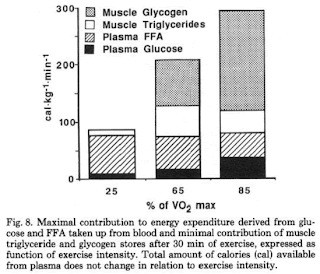 The key point to remember is that both fat and carbohydrates contribute to fuel our races and even at lower intensities carbohydrates play an important role! Our body have a limited storage capacity for carbohydrates (store as glycogen) while we have ‘unlimited’ capacity for fat (not really but we store much more fat than carbohydrates) hence we need to place special attention on our carbs stores.
Depending on fitness, age, weight, etc. in general an athlete can store around ~500 grams of glycogen (~2000 Kcal) with roughly 400grams store in the muscles and the rest in the liver. Fat stores on the other hand are virtually unlimited, that is a 150 pound athlete with 10% body fat has 15 pounds available which is more than enough to get you through an Ironman.
The problem is that not matter how much fat you have available in your body, if you deplete your muscle glycogen you’ll be force to slow down. In addition, your brain requires a constant supply of glucose, if you deplete your liver glycogen you won’t be able to maintain an adequate blood sugar level and your body will shut down (“bonk”)
The take away message is that you need to replenish your carbohydrates fuel stores in order to avoid depletion and ultimate result in slowing down when training/racing.
How much fuel (carbohydrates) do I need when racing?
Here is where things can get a bit complicated because how much carbs you should consume when racing will vary based on:
For instance; if you have two athletes of the same weight and have them ride say 112 miles it will roughly cost them the same amount of energy (kilojoules – a mechanical measure of energy measured by a power meter) even though rider A might be able to complete the ride in 5 hrs while rider B in 6 hrs. The amount of energy needed was roughly the same; the difference is how quickly each of them covered the distance faster.
Knowing the above it would be safe to assume rider A was riding the course at a higher percentage of his/her power threshold (resulting in greater amount use of his glycogen storage) while B used less. What many AGers struggle with, is determining how much carbs/kcal they should ingest per hour and most over estimate it and end up experiencing gastro-intestinal distress. Many believe since they'll spend a longer time racing then they need more fuel!
To avoid this let’s compare rider A and B above and make some generalizations/assumptions to illustrate this point:
First let’s assume rider A rode at ~80% of his power threshold while rider B did at ~68% both requiring roughly ~3600 kilojoules (kJ) to cover the distance. We don’t use all our energy to propel our bikes as our bodies aren’t very inefficient at converting fuel for energy and some of it is lost as heat and through other physiological processes hence even though 1 Kilocalorie (Kcal) equal 4.186 kJ, since not every Kcal is use to propel our efforts, you can estimate your Kcal from a total ride kJ by multiplying your total kJ times 1.05 for very efficient athletes to 1.15 very inefficient.
A good enough guesstimate would be somewhere in the middle at 1.1; for the example above both athletes will need around 3960 Kcal to propel their efforts. But both riders didn’t start the ride depleted; assuming both optimally fueled prior the ride then both had at least 2000 Kcal or 500 grams (1 gr of carbs = 4 Kcal) at the start hence they need to supply only about 1960 Kcal during the ride.
Now, for rider A since he/she rode the course at 80% of power threshold then he/she needs to supply around ~1568 Kcal (80% of 1960 Kcal) or ~314 Kcal per hour (~78 grams of carbs) and the remainig ~400 Kcal will come from his/her fat storage which since it is ‘unlimited’ there is no need to supplement.
For rider B since 68% of his/her fueling demands will come from carbs then he/she needs 1333 Kcal or 222 Kcal per hour (55 grams of carbs) and the rest ~600 Kcal from fat. That’s around 100 Kcal per hour lower than ride A!
Of course the above doesn’t work exactly that way and I made generalizations/assumptions but i serves as a simple way to explain why even though many AGers spend more time on the course, since they'll racing at lower intensities they will need less fuel per hour even when they will endure a longer racing day. In general, their fueling needs will be lower since their fueling needs will be lower from carbohydrates and higher from fat than those racing less time but at higher intensities.
The take away message is that athletes have to develop fueling strategies based on their specific racing needs (fitness, intensity, duration, et.). If you have a power meter and a GPS you can use the information to estimate Kcal intake needs easier and use the data to determine fueling needs testing it in race rehearsals. In the absence of that you can use some of the simple general ‘rules’ below:
2-3 days before a big race:
Using this information you can set a simple racing strategy and test it in your next long training day. Adjust it based on your specific needs and in no time you’ll know what you need to consume to fuel your training/racing; what’s best is that you’ll most likely realize this can be rather simple and affordable. I hope this helps you find the best fueling strategy for you!
* Evidence suggests our bodies can’t process/absorb more than 1-1.2 grams of carbs per minute hence most athletes won’t be able to handle more than 60-75gr of carbs (240-300 Kcal) per hour in general.
Want to learn more? Sources:
In addition, anytime time we read race reports or listen to the stories of our fellow athletes regarding a bad racing experience, invariably there are 3 main reasons their races went south: 1) poor fitness prior the event, 2) poor pacing during the race and/or 3) poor fueling execution.
This time I am going to focus on the last point though in most cases the reason why athletes struggle during a race can be the mix of all 3 points mentioned above.
Nowadays with so much information available (though not necessarily good one) found in magazines, books and websites it is easy for athletes to get confused as to what is the best fueling strategy for them to follow would be. Many try to emulate what professional athletes do or follow one size fits all suggestions; for that reason let me break it down for you, there is no one optimal fueling strategy that will work for everyone.
We all respond different to training/racing and we’ll have different fueling needs based on our fitness level, age, gender, racing distance, racing intensity, goals, diet, what our bodies can tolerate, etc. That said, there are certain basic rules that can help you out to identify what’s the best strategy for you and over time through testing it out through training you can indentify what works for you. But before getting into that, let’s get a quick simplified physiology lesson.
Body’s Fuel sources
Anytime we exercise our body requires converting fuel to energy (ATP) depending on the duration and intensity of such exertion. The sources of fuel are carbohydrates, fat and protein that we all get through our regular daily diets. Carbohydrates and fats provide most of the energy we require when racing from a sprint to an Ironman while protein could be used but only on extreme cases such as in a depleted state though some studies have shown limited benefits from consuming branched-chain amino acids (BCAA) but still, the information available is inconclusive hence I won’t spend time discussing it in this article.
Since both carbohydrates and fat fuel us, we need to consider both as important though our body uses them differently depending on how hard and/or long we are working at a given time. In general fat provides a greater percentage of fuel for energy at lower intensities while carbohydrates provide a greater percentage at higher intensities. Around 65% of VO2 max or 75% of threshold our bodies roughly use around the same ratio. The table below illustrates this rather well:
The key point to remember is that both fat and carbohydrates contribute to fuel our races and even at lower intensities carbohydrates play an important role! Our body have a limited storage capacity for carbohydrates (store as glycogen) while we have ‘unlimited’ capacity for fat (not really but we store much more fat than carbohydrates) hence we need to place special attention on our carbs stores.Depending on fitness, age, weight, etc. in general an athlete can store around ~500 grams of glycogen (~2000 Kcal) with roughly 400grams store in the muscles and the rest in the liver. Fat stores on the other hand are virtually unlimited, that is a 150 pound athlete with 10% body fat has 15 pounds available which is more than enough to get you through an Ironman.
The problem is that not matter how much fat you have available in your body, if you deplete your muscle glycogen you’ll be force to slow down. In addition, your brain requires a constant supply of glucose, if you deplete your liver glycogen you won’t be able to maintain an adequate blood sugar level and your body will shut down (“bonk”)
The take away message is that you need to replenish your carbohydrates fuel stores in order to avoid depletion and ultimate result in slowing down when training/racing.
How much fuel (carbohydrates) do I need when racing?
Here is where things can get a bit complicated because how much carbs you should consume when racing will vary based on:
- Your fitness level - metabolic fitter people are able to increase their carbohydrates storing capacity.
- Your intensity - depending of what % of your threshold power/pace you race at will vary how fast you go through your fuel tank).
- Other variables like temperature, topography, weight, age, gender, etc.
For instance; if you have two athletes of the same weight and have them ride say 112 miles it will roughly cost them the same amount of energy (kilojoules – a mechanical measure of energy measured by a power meter) even though rider A might be able to complete the ride in 5 hrs while rider B in 6 hrs. The amount of energy needed was roughly the same; the difference is how quickly each of them covered the distance faster.
Knowing the above it would be safe to assume rider A was riding the course at a higher percentage of his/her power threshold (resulting in greater amount use of his glycogen storage) while B used less. What many AGers struggle with, is determining how much carbs/kcal they should ingest per hour and most over estimate it and end up experiencing gastro-intestinal distress. Many believe since they'll spend a longer time racing then they need more fuel!
To avoid this let’s compare rider A and B above and make some generalizations/assumptions to illustrate this point:
First let’s assume rider A rode at ~80% of his power threshold while rider B did at ~68% both requiring roughly ~3600 kilojoules (kJ) to cover the distance. We don’t use all our energy to propel our bikes as our bodies aren’t very inefficient at converting fuel for energy and some of it is lost as heat and through other physiological processes hence even though 1 Kilocalorie (Kcal) equal 4.186 kJ, since not every Kcal is use to propel our efforts, you can estimate your Kcal from a total ride kJ by multiplying your total kJ times 1.05 for very efficient athletes to 1.15 very inefficient.
A good enough guesstimate would be somewhere in the middle at 1.1; for the example above both athletes will need around 3960 Kcal to propel their efforts. But both riders didn’t start the ride depleted; assuming both optimally fueled prior the ride then both had at least 2000 Kcal or 500 grams (1 gr of carbs = 4 Kcal) at the start hence they need to supply only about 1960 Kcal during the ride.
Now, for rider A since he/she rode the course at 80% of power threshold then he/she needs to supply around ~1568 Kcal (80% of 1960 Kcal) or ~314 Kcal per hour (~78 grams of carbs) and the remainig ~400 Kcal will come from his/her fat storage which since it is ‘unlimited’ there is no need to supplement.
For rider B since 68% of his/her fueling demands will come from carbs then he/she needs 1333 Kcal or 222 Kcal per hour (55 grams of carbs) and the rest ~600 Kcal from fat. That’s around 100 Kcal per hour lower than ride A!
Of course the above doesn’t work exactly that way and I made generalizations/assumptions but i serves as a simple way to explain why even though many AGers spend more time on the course, since they'll racing at lower intensities they will need less fuel per hour even when they will endure a longer racing day. In general, their fueling needs will be lower since their fueling needs will be lower from carbohydrates and higher from fat than those racing less time but at higher intensities.
The take away message is that athletes have to develop fueling strategies based on their specific racing needs (fitness, intensity, duration, et.). If you have a power meter and a GPS you can use the information to estimate Kcal intake needs easier and use the data to determine fueling needs testing it in race rehearsals. In the absence of that you can use some of the simple general ‘rules’ below:
2-3 days before a big race:
- Be particular proactive to consume carbohydrates (plus lean protein and good fat) to make sure your glycogen storage is full but use common sense; use good sources of carbohydrates (low glycemic index) and don't over do it.
- 2-3 hrs before racing window; 1-2gr of Carbs x KgBW (Kg of body weight). The longer the race or the harder you’ll race consume upper end. Avoid consuming food with a high fat or fiber content to avoid GI issues.
- 1 hr or less before training window - consume 15-24oz sports drink OR water plus gel per hour. If you did a good job fueling 2-3 hrs before you don’t need much, you just want to stay hydrated
- Sprint race; 0.5-0.7gr CHO x KgBW per hour - consume lower end if it will take you less than 90 min or higher end if over 90 min
- Olympic race; 0.7-0.9gr CHO x KgBW - consume lower end if it will take you less than 2:30hrs or higher end if over 2:30 hrs
- HIM race; 1-1.2gr CHO x KgBW - consume higher end if it will take you less than 5:30hrs or lower end if over 5:30 hrs
- IM race: 1-1.3gr CHO x KgBW - consume higher end if it will take you less than 10:30hrs or lower end if over 10:30 hrs
- 0.5-1.1gr CHO plus 0.1-0.3gr of protein x KgBW depending on duration/intensity of session (goal - stabilize glucose levels in the liver, improve recovery processes, etc)
Using this information you can set a simple racing strategy and test it in your next long training day. Adjust it based on your specific needs and in no time you’ll know what you need to consume to fuel your training/racing; what’s best is that you’ll most likely realize this can be rather simple and affordable. I hope this helps you find the best fueling strategy for you!
* Evidence suggests our bodies can’t process/absorb more than 1-1.2 grams of carbs per minute hence most athletes won’t be able to handle more than 60-75gr of carbs (240-300 Kcal) per hour in general.
Want to learn more? Sources:
- Int J Sports Med 1980; 1:2-145. Sports Med 1992; 14: 27-42
- Metabolism 1996; 45:915-921
- Am J Physiol Endocrinol Metab 1999; 276: E672-E683
- Med Sci Sports Ex 1993; 25:42-51
- Int J Sports Med 1994; 15:122-125
- Horm Metab Res. Jan;40(1):24-8, 2008
- J Appl Physiol. Nov;105(5):1462-70, 2008
- Eberle S, Endurane Sports Nutrition, Human Kinetics, 2nd Ed, 2007.
YouCoach - Training plans
Want To Get Started? Complete your Fitness Assessment Today!

What is it?
This service is a simple yet complete model with general-semi personalized training plans, multimedia content, online advice and social interaction through a private forum. This provides an effective alternative way to training with expert advice from E3 coaches for a lower cost.
This service is more of ‘Do It Yourself’ model for athletes. In simple words; we provide you with season plan with detailed workouts, we provide you the tools (plan, guides, calculators, testing, videos, etc.), we provide you expert support and YOU do the Coaching matching the plan to fit your specific needs. This allows athletes to have a direct control over their training schedule.
This service will suit better those athletes who enjoy taking control of their program, require minimal coaching support and with a flexible schedules or for those wanting to be more involved with their plan and learn at the same time.
It is very simple:
- The athlete fills up a fitness assessment and submit to us, we analyze it and based on that info provided recommend what plan level will fit the athlete needs.
- We submit the first 4 week block plan, “how to” guides and schedule a startup conference call to discuss the details of the plan, terminology, goals, etc.
- We also give the athlete access to the private forum where he/she will have access to different multi-media and personal thread in which he/she can ask any questions in order to further adjust the plan to match his/her need; those will be answered by our coaches within 24-48 hrs.
- During the last week of the 1st block, the athlete will complete the fitness progress assessment with detailed feedback so we can recommend the next 4 week block that will fit his/her needs and goals. We do this at the end of every block.
Sample Annual Training Plan for Out of Competition - Level 2


Sample Week # 1 for Out of Competition 12 Week Plan - Level 2

- Initial fitness assessment
- Annual training plan
- 8, 12 or 20 week training plan delivered on 4 week blocks
- Monthly fitness progress assessment
- Personal thread and unlimited online support via web based private forum
- Access to the various how to guides, multi-media and PBM coaching articles provided via forum, blog, website and Facebook page.
- Discount for performance services and training camps
- If you have a beginnertriathlete.com training log you can upload our plans into your log.
What It Doesn’t Include?
Please notices that our online support service is neither personalized coaching nor do we design provide individualized training plans, for that we offer one-one one coaching.
The plans are pre-designed and are developed to fit most athletes’ needs. The addition of online support via the private forum will enable the athlete to ask any questions to our coaches for ideas and tips as to how to adjust the plan.
- This model doesn’t include the integrative performance services we provide for our one-on-one athlete.
- Our coaches won’t monitor or provide specific feedback through a training log.
- Though we won’t make changes to your training plan, we will give you feedback so you can adjust it.
- We won’t do personalized power, GPS or HR monitor file analysis or performance modeling.
- Unlike our one-on-one athletes, we do not provide training log access, there are many free or paid available options around

Want To Get Started? Complete your Fitness Assessment Today!
Cost - iCoaching + Training plan
Out of competition plan (8 or 12 week plan), Olympic (5150), 70.3 or IM (12-20 week) Heart Rate/Perceived Exertion Based - $50.00 per month (Plus Paypal charges)
Out of competition plan (8 or 12 week plan), Olympic (5150), 70.3 or IM (12-20 week) Powermeter/GPS pace Based - $60.00 per month (Plus Paypal charges)
Cycling (Road, Crits, Cyclo-Cross, etc) heart rate based - $35.00 per month/Power based - $40.00 per month (Plus Paypal charges).
Running heart rate based - $35.00 per month / GPS Pace - $40.00 per mont
Subscribe to:
Posts (Atom)