Showing posts with label boston triathlon team. Show all posts

Racing Week Review

Another successful racing weekend for E3 athletes and friends:

On Thursday:

  • Jessica Douglas ran at the 4 miler Gobble Gobble as part of her comeback to racing and posted a PR with a 29:34min time!
On Saturday:
  • Noah Manacas race at the Baystate Cyclocross day 1 and posted a great result finishing top 20 on the Cat 4s 35 masters
  • Carrie Mosher also raced at Baystate Cyclocross day 1 and finished 13th on the Females Cat 4s.
On Sunday: 
  • Noah Manacas race at the Baystate Cyclocross day 2 and posted improve his result finishing 19th on the Cat 4s 35 masters
  • Carrie Mosher also raced the Baystate Cyclocross day 2 and improved her result from Saturday finishing 11th on the Females Cat 4s
At Ironman Cozumel E3 athlete and Level 1 coach Brett Johnston successfully completed his 2nd Ironman  every finishing with a huge personal record of 10:40 hrs compared to his 12:16 hrs from Ironman South Africa last year. Brett improved on all 3 disciplines posting a 1:13 hr swim (4 min faster), a 5:33 hrs bike (55 min faster) and backed it up with a killer 3:47 hrs marathon (27 min faster), resulting in a 1:36 hrs time improvement!

Coach Brett is not only getting faster, but he is also getting smarter; chech the links if you want to learn more about our Coaching Programs, Performance plans or Online Coaching YouCoachTM

Fellow Boston Triathlon Team member and friend James Strain also had a killer result finishing on 9:40 hrs and 7th place AG.

Friend and Pumpkinman Race Director Kat Bianconi Donatello also had a killer race and PR finishing in 11:24 hrs. Congrats to Kat and her coach!

Great results everyone, congrats!


Bad Races Happen To Any Athlete

By Brett Johnston

Last week, I headed to Sharon with a large contingent of my teammates from Boston Triathlon Team to do “The Sharon Triathlon”. I had been shopping on Saturday and picked up my long awaited Powertap and new wheel, but common sense prevailed, and I decided to race with my regular race wheels and not make the far too common error of trying to race on/with new equipment.

Race day was great…up early, to the race site with no problems although I did not have my updated USAT card…but thanks to technology, I was able to get it up on the website on my phone, so I did not have to pay the extra 10 bucks…good deal. There were only 4 or 5 waves for the race, and I was in the 1st wave, which I think was males 39 and under. There was a long starting line, as it was an in water start, so we were only 1 or maybe 2 deep for the start.

The swim is ½ mile swim in a kind of rectangle shape, so you end close to where you start.
Race started and I went off pretty strong,(which for me is something new this year, as I usually waited towards the back and then started swimming once the “madness” had subsided, but at my last few races, have done the quick start, and it has worked out great).

Nothing out of the ordinary happened, other than the usual flailing arm, foot fist, and the odd gulp of water, but I was already into a rhythm, so all was good. After about 150 meters or so, as I was getting up to the 1st buoy to make the right turn, I started feeling very restricted in my breathing, almost as if my wetsuit was tightening around my chest.

I rounded the buoy and it started getting harder and harder to breathe, keep my rhythm or focus. Before I knew it, I had switched over to Breaststroke…what? Breast Stroke?... do I even remember how to do Breaststroke?? I would do a few strokes of breast stroke to “try” and catch my breath and then  switch back to freestyle, but to no avail.

What was going on? No matter what I tried, I could not get my breath back, and was really struggling…this was not good. For the next part of the swim, which took me close to the half way point in the swim. I was all breaststroke, and not getting any better. By the time I made the turn-around, I had made up my mind to finish the swim. But I was constantly looking where other swimmers were, and more importantly (because the other swimmers would probably not have been in a position to help me, should I have really needed help)where the kayakers were, and was always trying to keep them close-by and in sight, and making sure that they were aware of me and where I was.

Eventually, I made it to the finish of the swim, and literally stumbled into T1. I had one of my swim teammates who was on a relay team, ask me if I was ok, as she said “you look tired!”, to which I could not even reply and just shook my head. There was an EMT standing there too, who also questioned me to make sure I was coherent.Anyhow into T1, taking all the time in the world, I tried to relax, get my breath back, and see if I could coast through the bike.

No such luck, as soon as I started pedaling to get any sort of speed , I would have a hard time breathing and started coughing. Finished the bike, and went out onto the run…I mean walk. Why did I do the run course? For me it was really just to have a better gauge on what the problem was. I could monitor my heart rate easily, and see where/what was bringing on the tightness in my chest. Essentially I could walk no problem, or do a very slow jog for about a ½ mile, and then needed to revert to walking, which was what I did.
I eventually finished the race, and then spent the next few days trying to analyze it…and here are MY findings.

I am certain that I had the start of some sort of chest infection that had not manifested itself until the start of the swim. ( My wife had been home sick with a throat infection the week before and my 6-year old had a cough for the whole week)
·         If I had known this before the race, I would not have started, and in hindsight, I should have abandoned the swim when I knew that something was "not right".
·         The rest of Sunday, Monday and part of Tuesday, I was coughing a lot.
·         Doing my 1st workout since the race on Wednesday, which was an open water swim, I was certainly better, but when paying close attention to my breathing, I could still “feel” the wheezing in my chest.

What I learnt:
·         You don’t know what you don’t know J .
·         LISTEN to your body ( I really did this, even in the swim, I was not trying to do anything that would have caused my body MORE stress than what it was already going through, and the same on the bike and run)
·         Sometimes you will have a bad race, and if it is out of your control, then that is not a bad thing.
·         LEARN from experiences. This had NEVER happened to me before, and I hope will never again, but like any experience, you learn from it, and hopefully better prepare yourself for the next time.
·         It is ONLY a race…. I was there to enjoy it and have fun (and naturally to do well), but at the end of the day, triathlon will always be around and there are many more races….My life on the other hand is very special J

About the Author: Brett Johnston is an Endurance and Triathlon coach with E3 Training Solutions.

Racing Week Review

Another successful racing weekend for our E3 athletes:
  • Brendan Hall finished 2nd in his AG at the Timberman Sprint
  • Brenda Chroniak had a strong showing at the Timberman Sprint with a 12th AG
  • Ed Galante came back from a tough IMLP to successfully complete the Timberman Sprint
  • Patricia Brownell had a tough showing at the USAT AG nationals fighting a cold but finishing the race
  • Noah Manacas raced at the Timberman 70.3 with a solid performance
  • Sean McCormmick raced at the Timberman 70.3 with a solid performance
From the Boston Triathlon Team teammate Trish Henwood earned her spot to ITU Sprint Worlds. Also Matt Pokress did the same for ITU Olympic Worlds. Maggie O'Toole had a great PR at USAT AG Nationals finishing 2nd AG.


Friend Grace Tsuei also successfully completed the Timberman Sprint and had the 12 fastest swim overall!

Also some of the ladies from our PBMC friends had another killer racing weekend, Catherine Sterling and Meghan Newcomer won their AG at USAT Nats becoming national champions. Finally, Mike Caiazzo from the US Pro Tri team had another great result finishing 2nd OA at Timberman 70.3. Great job coach Kurt!


Congratulations to everyone!

Racing Week Review

Intense cycling racing weekend for some of our E3 athletes in addition to some tri and run racing:

  • Andrew Thompson battled tough winds/rain to finish 3rd at the Texas Time Trial Championship with a sub 1 hr performance. He also competed on the Team Time Trial the next day but with a man down it was a battle to finish
  • Analise Thompson also competed at the Texas Time Trial Championship and finished 9th OA Cat 4s
  • Carrie Mosher had a great showing at the Norwell Circuit race finishing top 15th
  • Carrie also raced the Whaling City Tri with minimum tri training and finished 9th AG
Blue Hills Cycling Club teammate Bryan Murphy finished top 10 at the Masters 45+ Cat 1-2-3 at the Norwell Circuit Race!

E3 friend Ryan Case raced his 1st 5K and finished in 17:51m good for 3rd OA and 1st AG!

Also a big shout out to our ETA and PBMC friends; their athletes had another successful racing weekend. Also props for our EC friends who hosted the Rev3 Anderson training camp.

E3 Athlete Spotlight

A new feature I am adding to the E3 Training Solution Blog is going to be ‘E3 Athlete Spotlight’. This will be a simple way to feature some of our athletes, share a bit of who they are, what are they racing, why and some extra random information. This is my way to recognize the hard work and sacrifices our athletes have endure over months of training.

Since Ironman Lake Placid is one of the most popular races in the Northeast I decided to feature those of our athletes racing it this year for the 1st or 2nd time. The first athlete, friend and fellow Boston Triathlon team member is Ed Galante. He did his 1st Ironman last year beating the odds after 5 knee surgeries in previous years the last one occurring just a few months before the race.

Ed is one of my close friends and this year he faced a different training challenge; he had to balance an incredibly hectic work schedule and the never ending knee rehabilitation with Ironman training. Still, he got the work done within his own limitations, this coming Sunday will be toeing the line for a 2nd time at Lake Placid.


Name - Ed Galante

Age - 39 (racing as 40)

Gender - Perfect Male

Profession - Corporate Attorney

Years racing - 10ish

Experience racing - 1 Ironman and countless tris of other distances, road and swim races.

Why you started racing tris? Had to give up rugby because of knee injuries and it looked like fun. Besides how many sports can you perform only okay on 3 separate disciplines, but the end result is actually good?

Favorite food - Pizza

Favorite motivation movie - Karate Kid and Rocky 1 through IV

Favorite movie Megashark versus Giant Octopus

Nickname Chupacabra

Alter Ego Mitch

Why you chose to race Ironman?  Because I am like a piece of Iron....and I am THE Man! So you combine the words and get "Ironman"....not sure if you picked up on Ivan Drago reference there.

Have you enjoyed the journey? I am not so sure I would use the word "enjoy" but it definitely has been a challenging experience. It also has allowed me to see how sadistic my friend Jorge is.

Training Concepts Part 4 - Periodization (1a)

In this miniseries within the training concept one I will discuss periodization. On part 1 I’ll address what is it, its history and some of the 1st models, on part 2 I will touch about modern models and what is NOT periodization and on part 3 I’ll discuss examples as to how to apply it and why general schemes are not suitable for all athletes.

Intro
All training principles derived from physiology have the main goal to optimize the workload during training. The type of training chose for an individual should place a constant overload, produce a specific effect and always be based on the athlete’s specific needs, goals and limitations.

Continuing my training concepts series, this time around I’ll introduce the periodization concept, explain what it is, provide some history and then discuss some of the misconceptions about, some examples and on part 5, I’ll finish this series discussing the performance equation and discuss tapering.  If you missed Part 1 (Stress/Strain/Adaptation), part 2 (Training Load) and Part 3 (overload/specificity/reversibility), check them out!

What is Periodization?
In simple terms, it implies subdividing a training program into a periods of general and specific training (usually a year, though it can be based on a shorter or longer term) with the goal to perform an optimal load to achieve peak performance at some point into the future.

On Part 1, you learned about the effect of training and how with an optimal program, your body will constantly adapt and due to the type of training you do (training load mix) and its accumulation will result in specific physiological adaptations improving your fitness.

Considering that, if your goal is to maximize the fitness gains, then an adequate program with optimal training loads. To accomplish that you should consider:
1.       Set specific goals based on your needs
2.       Address your limitations (i.e. time availability, weaknesses, etc.)
3.       Vary the forms training load (duration + intensity)
4.       Constant monitoring of the performance equation (Fitness – Fatigue = Performance)

The difficulty most athletes face is to develop a program accomplishing the above, in particular since they can’t train everything at the same degree all time.  Understanding and using the periodization concept can “simplify” this process. Before getting into the details, let’s first do a quick review of the history behind it. This will help clarify some of the current misconceptions and misinformation commonly found in training books, websites, magazines, etc.

A History Lesson
The beginning of periodization can be tracked back to the second century AD to ancient Rome and Greece. An example was the famous Roman physician and philosopher Claudius Aelius Galenus proposed the categorization of exercises. He suggested a sequence of exercises focusing 1st on “speed apart from force”, then “strength apart from speed” and finally “combining strength and speed”.

Another example was the Greek scientist Philostratus who described on his “Gymnasticus” essay the Olympic preparation of athletes focusing on a 10 month training period followed by 1 month of “specialized” preparation; his essay included short and long term training cycles.

Contemporary theories of periodization were first proposed in the former USSR where coaches/scientists called for the division of a training program into separate periods. This separation allowed addressing different goals and target different adaptations over the course of a program.

Specifically, the main concept behind periodization evolved from these theories, in particular the need to structure these periods from general preparation to specific preparation (key focus used by most elite coaches nowadays).

The first known attempt at compiling scientific and empiric concepts was produced by Russian Lev P. Matveyev who analyzed the preparation of Russian athletes prior the Helsinki 1952 Olympic games. He asked athletes from different sports to complete a questionnaire regarding their training and this became the foundation of his thesis later known as the periodization model.

Matveyev stated that fitness behaves in cycles influenced by training and that it can be manipulated in order to advice peak performance for a particular competition. He also suggested, preparation should follow a progression from general to specific training (in my opinion his best contribution).

His model primarily proposed a structure in which the body should be stressed manipulating load and that there is a reverted relationship between volume and intensity. Based on this he proposed to make the focus of the first portion of the training (general) producing training effects via high volume/low intensity and then switch the focus for the second portion (specific) producing training effects via short periods of high intensity/low volume.

In his classic single model, Matveyev makes distinction between periods; one or two periods for preparation, one for competition and one for transition. He also suggested different focus in terms of general and specific conditioning through the different periods changing focus from condition, technique and competition specific training. He also added a double and triple periodization model to target 2-3 competitions through the year.

Still, the greatest limitation of this model is its simplistic approach considering training load; in spite of the specific characteristics of an athlete’s needs, limitations and goals (competition), the model largely suggest first a volume/low intensity approach and then a short focus on intensity/low volume previous to competition ignoring specific physiological, psychological and morphological adaptations. This can work well in untrained individuals but as fitness improves in the long term in can become insufficient.

As a side note; Matveyev is considered the father of periodization, and not Tudor Bompa. Bompa developed his theories based on some of the USSR thesis and later brought his interpretations into to Western Cultures through his books.

Interestingly enough, many of the periodization structures used today (particularly in triathlon) used by some coaches/athletes resemble Matveyev’s approach and more precisely, Bompa’s interpretation of it. Its popularity seemed to be the result of a popular triathlon book (with the word bible in it). However, while schemes based on this can be successful under ‘certain’ circumstances, as you will learn reading this series, its use is certainly not applicable to all athletes and/or distances.

Over the years Matveyev’s model wasn’t supported by many scientists/coaches and in fact was heavily criticized because it wasn’t developed based on physiological processes and instead derived from anecdotal evidence from athletes competing in various disciplines. In addition, the model was thought to be unsuitable for many athletes (in particular elites) as it ignored the specialization in competitions even within the same sport (i.e. 10K training vs Marathon training). Because of that other models emerged mainly opposing or questioning his model.

Scientist Peter Tschiene (German) was among them who focused on the fundamental biological changes that take place while training, rather than relying on an empirical model of periodization.  He argued Matveyev’s classic model was unsuitable especially for elite athletes. Tschiene constructed a model with different periods (preparation, competition and transition) but it included a mix of volume and intensity throughout the program (except for the transition period).

His focus was more specific to the physiological adaptations different training load incurs, though his model placed a greater demand on the athlete through a continue strain/stress/adaptation.  Tschiene greater contribution was the introduction of frequent load alternated with recovery forcing a constant adaptation for athletes. Still, due to the exceptionally heavy load this model might produce, it could only be applicable for athletes capable of handling the demands but also able to applied a wide variety of measures for adequate recovery.

Another critic of Matveyev’s model (as well as Teschiene’s one) is Russian sport scientist professor Yuri Verhoshansky. Same as Tschiene, Verhoshansky focused on the fundamental biological changes produced by different training loads. In his model he proposed a process of physical adaptation as the starting point. He designed a periodization model directed with different workloads targeting specific adaptations and discovered a phenomenon he called the “delayed effect of training”.

He realized there is an adaptive mechanism based on training load and the body’s ability to adapt to the training stimulus. A particular load will produce a particular stimulus producing certain adaptations, and even though this can lead for fatigue to accumulate resulting in a drop in performance in the short term, adaptations will remain and improve after a period of lower workload. By dividing the training load addressing specific adaptations through the periods, one can maximize gains and take advantage of the delayed effect of training or in simple words, the lingering achieved fitness.

Which one is better?
In my opinion, nowadays Matveyev’s model seems outdated and limited considering our understanding in physiology and how different training loads can lead to optimize specific adaptations. Still, his model could be applicable to certain group of athletes and he set up the foundation of periodization identifying the progression from general to specific training.

Likewise, while Tscheine’s model can be demanding for many athletes or even impractical for others, his contribution to consider physiological adaptations and a mix training load enhanced modern periodization. Finally, Verhoshansky’s model limited the focus of training to specific adaptations; he enhanced modern periodization by identifying  how different workload enhance different adaptations and while initially this might lead to a drop in performance due to fatigue, as super compensation occurs  fitness will linger and performance will improve.

With that in mind, most elite coaches nowadays based periodization in a mix of these 3 models (mainly Tschiene and Verhoshansky) because it enables them to address modern athletes specific needs (including age groupers).  On part 2 I’ll discuss in detail modern periodization models and debunk periodization misconceptions. Stay tuned…

Racing Week Review

Another successful racing weekend for E3 athletes and team members/friends from the Boston Triathlon Team

  • Alaina Neary Case raced the Musselman sprint and half iron; she finished 2nd female overall for the sprint on Saturday and on Sunday she fought some stomach issues and still managed a 4th place overall at the Half!
  • Ryan Case (E3 friend) also race at the Musselman sprint/half iron; he finished 2nd AG at the sprint and similar to Alaina, he experienced issues though his were mechanical finishing 5th AG. Way to get it done even with adversity!
  • Noah Manacas raced at the Stowe 8 miler and posted a solid 1hr time!
  • Kirsten Knowles raced at the Stowe 8 miler a week after the Missoula Marathon were she PR and posted a solid ~1 hr result
  • Brenda Chroniak raced as well the Stowe 8 miler posting a solid 1:04hr time
  • Amy Duverger also raced the Stowe 8 miler posting a solid 1:11hr time
Fellow team members for the Boston Tri Team also had great racing results specially at the Fairlee Tri where many members made the podium: Brian Kearney won the Clyde division, Rachel Saks Aronis placed 3rd AG, Kelwin Conroy placed 3rd AG, Maggie O'Toole 1st Athena, Trish Henwood 2nd AG, Ira Sills 2nd AG and others I don;t have their results just yet.

Congrats to you all! 

Jana's Rev3 Race report - coach perspective - part 3 (final)

This is the final portion of the Jana’s race report from my perspective as a coach. On part 1 I shared some information about her training in previous months leading to the race. On part 2 I shared in general her final preparation before Rev3 and also her fueling plan based on data like her energy expenditure and some of the products she uses for training and racing.

In this final portion I’ll focus on her plan before the race and the execution. Before every major race I give each of my athletes a detail racing plan with info regarding their nutrition for the 3-5 days prior an event plus other relevant information about equipment, traveling, etc. I also include specific information about the race (like registration), some DOs and DON’Ts prior a major event, and even some specific things I want them to visualize to make sure they are ready for any challenge during the race.

The main portion of the plan is the pacing plans, that plus the fueling plan we practiced during the specific phase on the weeks leading to the race (like the one I shared on part 2) are the key aspects of proper execution. The pacing plan is developed on all the data collected during training and adjusted due to the last bit of increase in fitness achieved during the taper. Finally, I consider the race course profile and adjust the pacing given the terrain including key points in the race.

With the above in mind, below there are some elements of Jana’s racing plan, keep in mind below is a short version:

Swim
Suggested Pacing: Moderate pace – Time sub 35 min.
Summary: Start at the front of the pack; the first ~200 yards start a bit faster than race pace to attempt ‘catching’ some of the fast swimmers feet. Then settle down into race pace focusing on navigation. Last ~200 yards pick up the pace a bit, begin visualizing T1 and get the legs ready for the run to transition.
Actual Swim Time – 38 min (32nd place Age Group, 105th overall female)
Analysis – As mentioned on part 1, we have been focusing on improving Jana’s swim (her Achilles) but we had limited opportunities for open water swim. This probably was the reason for the slower swim. Still, her fitness in the water is better than last year, hence even with a slow swim, she had the energy to tap into for the bike/run.

Transition 1 Suggested time – sub 2 min (actual 1:59min)
For all my athletes, we always try to avoid wasting time in transition as one can really gain on the competition. The run from the swim to the bike was a bit long and Jana is still mastering the ‘taking the wetsuit off’ skill, still she was within the goal and the fastest among the top 5 gals.

Bike
Suggested Pacing: Current Critical Power (CP) – 240watts (230w on my PowerTap wheel*) – Target for the race 180 watts
*My racing wheel which Jana borrowed is a Hed Jet 90 with a Powertap 2.4, usually this wheel reads a bit lower of my other powertaps hence I always adjust my pacing based on that. In Jana’s case even though her CP was around 240watts, I used 230watts to develop the pacing strategy.

Summary: Intensity Factor target - ~79-80% of CP, average watts (AP) – 180-185w, Never exceed 240w!!!
Power on flats – 180-185w, if riding with tail wind – 180w, if riding with head wind – 185w
Power on climbs- If short hill (less than 3 min) 200-205w, if long climb (longer than 3 min) 190-195w

Suggested pace for first 18.6 miles – 175-180watts (actual during the race ~175w AP/ 180w NP)
Suggested pace for first 18.6 miles – 180-185watts (actual during the race ~178w AP/ 185w NP)
Suggested pace for last 18.6 miles – 185watts (actual during the race ~177w AP/ 183w NP)

Actual Bike pacing and time – 177 watts average (AP), 183watts Normalized Power (NP), Intensity Factor 0.79 (IF),  AP/NP = 1.03  2:46 hrs (including run to T2). (2nd place age group, 5th overall female). 


Fueling - ~70 gr Carbs (2.5 scoops powerbar perform/24 oz water + 1 powerbar gel + 1 bottle of water per hour)

Analysis – Ever since I started working with Jana I made her a power convert and she has been training with power ever since. She has a PowerTap 2.4 similar to their Pro +. The advanatge of guding her training with power and adjusting on race day based on perceived exertion and racing conditions allowed her to take guessing out of the equation and refrain her from doing any pacing mistakes. She knew based on her current fitness (critical power) and her training, what level of effort you should be able to sustain over 56 miles and common sense adjustments based on 'feel' would allow her to post a good bike split while leaving enough energy in the 'tank' for the run.

Jana did a great job pacing close to her target. Her average watts were within 3w of her race plan target (180w) and her normalized power (the metabolic cost of the ride) was 183w within her race pace range (180-185w). This means she did a great job pacing within her capabilities and she avoid having power spikes that in the long term not only result in a variable ride (AP/NP) but also in general zap the energy out of athletes legs, especially during the run.

This can is more obvious based on the plan recommendation to avoid going over 240watts; on her power file she only went over 240w 7 times during the race all was for less than 10 seconds. On the picture below of Jana's power file you can see this, the top dashed yellow line was the ceiling she was not supposed to pass during the race (240w) and the line below was the power target for the entire race (180w).
I assume the power spikes were the result of some efforts when climbing or passing a competitor. Also we divided the race in 3 segments and she had wattage targets for each based on terrain and strategy (presented earlier). You can see what we planned vs what she actually accomplished; all in all she was very close every segment, though in the end she slowed down a bit, perhaps due to the heat/terrain.

Jana's power file Rev3 Quassy
As a side note, before the race after driving the course and knowing Jana’s bike position (CdA, Crr, etc) we thought she could ride around ~2:45hrs with good conditions, she rode 2:46:47! This plus following the fueling plan she practiced through training yielded her to post the 2nd fastest bike split of the day among female Age Groupers and 14th including female pros; it also allowed her to pass 30 gals in her AG and 100 female overall getting back to T2 on 2nd place AG and 5th overall female.

Transition 2 suggested time sub 1:30 min (actual 1:05min)
Great transition, in and out! She again had the fastest T2 among the top 5 gals, hence she was able to get some of the lost time on the swim back and exiting T2 ahead on the leading female in her AG.

Run
Suggested Pacing: Pace target 7:10-7:15 min/mile (before I saw the run course). Adjusted to 7:25s-7:30s after seeing the course!

Summary – the day before we drove the run course and realized it was much more challenging that what we estimated from online map courses, hence I immediately adjusted her pacing plan. Usually I advise my athletes to guide all their effort primarily by perceived exertion and use pace/power as a way to assure they are not doing anything ‘stupid’ specially on early stages of the bike and run. In this case, Jana’s plan suggested to start ‘a bit’ easier (7:35s) for the first few miles, then settled onto 7:25-7:30s until mile 10ish and hopefully close at faster than 7:25s on the last 3 miles.

Actual Run pacing and time – 1:39:16 hrs 7:35s min/mile


Fueling - ~45 gr of Carbs (a few cups of sports drink, a few cups of water and 1 powerbar gel per hr)

Analysis - The pacing advised was relative because of the nature of the course. The run was very challenging with plenty of steep hills hence she knew that when going uphill (which that course had plenty of) she would have to adjust her pace by feel. In other words, when going up, the pace would be much slower than the planned 7:25-7:30s because of the inclines/gravity, but her effort should “feel” like she was running 7:25-7:30s on a flat terrain.

Unfortunately we couldn’t collect much run data as Jana’s Garmin died the morning of the race so I only have the splits from the race. She paced the 1st 5.5 miles at 7:29 min/mile which was a bit faster of what we planned. On the next 5.4 miles her avg was 7:28s min/mile which was on target with the plan. The last portion (2.2 miles) her pace dropped to 8:06 min/mile

Considering the above, I think the fact she started a bit too fast cost het to slow down when she needed to be the fastest. That plus the tough terrain and the heat which increased on the 2nd portion of the run lead me to believe were the main factors that caused her decrease in speed. Jana managed to exit T2 in 1st place of her AG which we held for until the end, still, at one point she was as high as 4th placed overall and eventually she got passed to finished 1st in her age group and 5th female overall.

All in all a great result, still, we will continue to address her swim and tweak some of the execution details like starting the run a bit slower to close strong and avoid running almost 1 min slower of what she is capable (for that course). That will be the focus for coming races.

There you have it, a race report from a coach’s perspective. I hope the info provided can be useful for some of you and apply it to your racing! Also, perhaps the info above might make you consider learning how to train with power, of you choose to do so, you should consider CycleOps power meters. They offer great products for a great value!

To learn more about our programs, visit www.e3ts.com , Happy training...

Wednesday Track Workout @ 630p - Victory Field, Watertown

What – Track Workout
Who – You!
Where - Victory Field, Watertown
When - 6:30pm
Workout: Strength Specific

Warm up - 15 min easy pace run, 5 min dynamic stretching
Main Set

For those training for 70.3, Ironman ,Marathon
3 sets of:
- 1x Plyos (1st set – 15-20 squat jumps, 2nd set – 15-20 split squat jumps & 3rd set 15-20 lateral jump)
- 1 x full hill repeat @ Tempo pace (up Bradford Rd all the way to Fairview Ave.)
-- Easy jog downhill as rest --
- 1 x 1000s @ Threshold pace
-- 1-2 min rest walking towards --
* If running less than 30 miles per week run 600s instead 1000s

For those training for Sprint, Oly, 10K, half-marathon
3 sets of:
- 1x Plyos (1st set - 15 squat jumps, 2nd set - 15 split squat jumps & 3rd set 15 lateral jump)
- 1 x ½ hill @ Threshold pace (up Bradford Rd to 1st stop sign Bellevue Rd)
-- Easy jog downhill as rest --
- 1 x 800s @ VO2 max pace
-- 1-2 min rest walking towards hill --
* If running less than 30 miles per week run 400s instead 800s

Cool Down 5-10 min run easy, 5 min static stretching
Total ~60 min (~6-7.5 miles)

See ya then!

Racing Week Review

Another successful racing weekend for E3 athletes and friends.

  • Dan Arnett continued his successful 1st year racing Xterra with a 2nd place on the Xterra trail and the next day he got 3rd at the Xterra Whitewater Tri.
  • Jana Richtrova (aka the Czech Chick) added a 3rd podium in as many races to her season with a 3rd AG and 2nd fastest AG bike split overall at the Providence 70.3 earning her spot for the Vegas 70.3 World Championship.
  • Brett Johnston participated at the Marlborough Tri as part of his preparation for Ironman Cozumel and he also finished on the podium in 3rd place AG!
  • Kirsten Knowles ran her 2nd marathon of the season and she PR with a 3:30 hr result and just missed the podium.
  • Patricia Brownell raced the Rev3 Portland Half Iron Distance and battled nasty blisters and still achieved a 7 min PR!
  • Kris Kaplan got back to racing and finished top 10 AG at the Marlborough Tri
  • David Hauser kicked off his Tri career with a top 10 AG at the Marlborough Tri
Our friends from the Boston Triathlon Team also had good results with Lauren Cullings, Mary Beth Begley and Janice Biederman all podium at the Old Colony Tri!

Our friends from PBM Coaching coached by Kurt Perham had great results as usual, noticeables were Catherine Sterling winning the elite amateur division at Life Time Fitness and Mike Caiazzo was 2nd Pro at Muncie 70.3


Jana's Rev3 Race report - coach perspective - part 2

After providing some general training information for Jana’s program on part #1, now I dive into what was the more specific prep for Rev3 Quassy Half Iron distance, how we set up her tapering scheme and how we set up her fueling plan.

When preparing racing and fueling plans for my athletes I based all the information on what they have done in training and what we have practiced fueling wise. Using devices like a power meter and a GPS/pedometer for collecting data allows me to not only do performance modeling, but also produce racing execution plans.

That is, I use the data collected (training rides, testing, races) and based on that I can estimate when I can expect for each to hit peak performance and when I need to start the tapering based on their current fitness per sport (as opposed to following some arbitrary general taper plan, a common practice by many). With that in mind and based on the experience from coaching Jana for a bit less than  year before Rev3, I knew she didn’t need more than a week roughly to bring her fatigue curve down while maintaining her fitness high and the offset of fitness minus fatigue will result in a peak in performance.

Since Jana raced the American Zofingen (Tough duathlon with 5 miles run, 29 mile bike, 5 mile run, 29 mile bike, 5 mile run) with  3 weeks prior Rev3, she had a big build up for that which also became part of the peak training during her specific phase as I intended in her season planner. That means Jana had 6 weeks of intense training before Rev3; I set up her build up with ~12 hrs of training per week with almost 60% of that done at intensities of tempo (30%), threshold (20%) and VO2max (5%) for cycling, 55% of tempo, threshold and VO2max for swimming, and around 50% for running. After that it was followed by a ~6 day taper reducing training load broke down as 6 days for running, 5 for cycling and 4 for swimming.

After Zofingen, she had an unload week (low training load) before having a last intense 12+ hr training load week (similar load break down as before Zofingen) and for Rev3, the taper was actually a bit shorter (5 days) broke down as 5 days for running, 4 for cycling and 3 for swimming. This decision was possible thanks to the data collected on her training and knowing the recovery rate Jana has for each sport.

Once the taper plan was settled, the next step was to tweak her fueling plan which she has trained with pretty much since Clearwater 70.3 and something we have just polish ever since.  Based on her power data Jana needs ~1650-1750 Kilojoules (kJ) to cover 56 miles at the same constant body weight (which oscillates between 127-128 pounds). Knowing that, the variable will be how fast or not she will cover that distance which will change a bit her reliance on carbohydrates vs. fats (the more intense you race, the more carbs you’ll need in general).

I won’t go into the details as to how I produce the carbohydrates needs for my athletes in their racing plans as I don’t want to give away the calculator I created, but it is not something I developed nor secretive. It is available out there in books, studies and the web for anyone curious enough to find out and with some excel skills to produce! You basically need to know the kJ, critical power (CP), race intensity (% of CP), current weight, an educated guess on efficiency and every day diet (food Kcal intake based on %s of carbs:protein:fat), we know she needs ~70 grams of carbohydrates per hour. This correlates well with what current evidence suggesting how athletes can absorb around 1-1.5 grams of crabs per minute or 60-90 gr of crabs per hour.

Using pace plus the info suggested above you can also estimate how much you might need for swimming and running (though the latter is trickier). For Jana based on her weight, race pace (intensity), distance, every day diet, the fueling consumed per hour when biking, and the fact it is a bit more difficult in general to digest fuel when running,  she can handle ~40-45 gr of carbs per hour. In terms of triathlons, we fuel before the race hence we have enough to get through the swim portion, for that reason, for anything shorter than an IM, I am not too concerned at determining in detail fueling needs for this leg.

Jana (like many of my athletes) likes to train and race with Powerbar products because those don’t upset her stomach and it is what you find in many races nowadays. We also like the fact Powerbar peform has their C2max blend which means having two sources of carbs allowing a better/faster absorption in our body. This might sound as a promotional ad, but their C2max blend is actually supported by current evidence suggesting that sugars like glucose, maltose and maltodextrin can be absorbed faster when exercising, and while fructose is absorbed slower, a mix of something like maltodextrin and fructose will allow faster/more absorption as the body uses two different pathways (‘doors’) to absorb it.

Also, Powerbar products make it simple for my athletes to determine their fueling needs based on our plans because they clearly indicate the nutrition fact per serving but also, they advise mixing directions which another key element when considering a fueling plan. If you don’t have an optimal carbohydrate concentration of your sport drink (carbs vs ounces of water) you might risk, GI distress or even something like side stitches (transient abdominal pain) which evidence suggest might be related with the consumption of hypertonic drinks (high carb concentration). Most powerbar products used a 9% carb concentration, which falls within the 6-9% suggested in current research.

Considering all of the above, you can see Jana’s fueling plan below that she has trained with on most of her long rides and/or race rehearsals and also what she used for Rev3. She made some adjustments on the go with water but for most part, the fueling aspect of her races is almost automatic. This means, she doesn’t have to worry much on fuel details, she already has trained this and when racing is a matter of executing and focusing more on the pacing portion.


As you can see the plan above (which is included in all of our One-on-One coaching programs or available as a separate service through our fueling plans) is very detailed and make it simple for the athlete to know how much and when they will need fuel. We always make some adjustments based on every race and weather conditions and the plan is a flexible guide that we tweak as need it.  

Many of my athletes and myself like Powerbar products because of their quality and the way they make it simple to use taking the guessing out of the equation. For full disclosure I am sponsored by them through the Boston Triathlon Tea, still, after trying many products over the years I still like PB better.  At the end of the day, there are many quality products out there so go with whatever works for you!

On part 3 (and last) well talk about pacing and execution. Stay tunned…

Racing Week Review

This weekend was a busy weekend for E3 athletes and friends full with great results.
  • Andrew Thompson fought hot conditions at the Buffalo Springs 70.3 race going sub 5 hrs and earning his ticket for the 70.3 World Championship in Vegas!
  • Analise Thompson had an amazing day finishing 2nd OA at the Buffalo Spring Lake Sprint with the fastest female bike split of the day. It seems the bike training is paying off!
  • Dan Arnett continued his great season placing 2nd OA at the Tri the Parks triathlon.
  • Patricia Brownell had a great performance at the Cohassett Tri finishing 2nd in her AG and earning a spot for USAT Nationals in Vermont... again!
  • Kirsten Knowles race the inaugural BAA 10K and set up a new personal record completing in 43:31
  • Amy Duverger also raced the BAA 10K posting a PR.
  • Noah Manacas and Brenda Chroniak also participated at the BAA 10k and had solid days with 44:xx and 50min finishing times.
  • Carrie Mosher completed the warrior dash obstacles course!
Athletes from the Liver Foundation team also participated at the BAA 10K setting PRs and having solid days; among them were Tom Murray with a solid race!

Grace Tsuei completed the 1 mile Captain pond swim and placed 3rd in her AG!

Boston Tri Team members also had fantastic results/accomplishments over the week at Tris, Ultras and obstacle racing!

Matt Davenport completed the Western States 100 and finished under 24hrs earning his belt buckle
Tony Felos completed his 1st 50 mile ultra in 13:39 min and 3rd AG!
Tris Henwood placed 1st AG, Sue McCloud was 2nd and Erica Allen was 3rd at the Cohasset Tri sweeping the podium!
Maura Olcese completed the Warrior Dash obstacles course race.

PBM Coaching athlete Catherine Sterling had another great day winning the Cohasset Tri

-- To learn more about E3 Training Solutions Programs, visit our website! --

Jana's Rev3 Race report - coach perspective - part 1

Last June 5, 2001 took place the Half Ironman distance race Rev3 Quassy; one of the fastest growing racing series and Revolution 3 is quickly earning a spot among the top triathlon production companies in the country. (good news for us triathletes!). The event also offers an Olympic distance race the day before and both take place at the Quassy amusement park in Middlebury CT which makes it an ideal venue for families as well as earning a reputation of one of the toughest races in the Northeast with a hilly bike AND run course.

Many E3 athletes participated either at the Olympic and Half Ironman distance and all enjoyed very much the event, the challenge and they achieved great results with podiums and personal records. Given Jana Richtrova (aka the Czech Chick) was the athlete I've been working with the longest and the one I have more data compiled, I decided to do a simple race report from a coach's perspective.

I hope this help you illustrate some of the preparation considered for each of our athletes, present you some of the many features our programs include and teach some of the things each of you should consider for your next race.

Let's start with a quick training summary: I've been working with Jana for a little less than a year now, last year she had a solid racing season with podiums and PRs at the Olympic and Half Ironman distance ending with her trip to the 70.3 World Championship in Clearwater, FL. The focus last year was to improve her fitness as much as possible while already in the middle of the racing season. This made challenging to address her weaknesses (her swim primarily, run secondarily) which forced us to focus on her strengths (cycling).

For this year, the focus changed to address her weaknesses while consolidating her strengths in the early part and later focusing on race specific fitness. Is no secret that her swim speed has been her Achilles heel ever since we began working together and we have taking a long term approach to improve it. We have seeing speed gains already but now we have to make those a reality in race conditions (open water). Rev3 posed a challenge as due to the nature of the weather in New England early in the year, Jana didn't have much opportunity to do open water swims and it showed in the race (more on this later).

Nevertheless Jana's Critical Swim Speed (CSS = the maximal speed she could sustain for roughly 3000 mts swim) has improved from 1:58 min/100 yds to 1:40 min/100 yds in 8 months. I actually think her CSS is faster but we'll confirm that in a coming test soon. Even though the Rev3 swim time didn't showed any improvements, I am certain was due to lack of open water swim practice and skills and for RI 70.3 things will be better. Still, it is important that her CSS is improving and you'll see why below when talking about critical power and critical velocity, not to mention the other benefits it might have provided, even when the swim time didn't reflected it.

In terms of cycling, her fitness which was good to solid to begin with has really improved at a very satisfying rate and has set her apart from her competition. Over the past 6 months post 'off-season', Jana's Critical Power ( CP = the maximal power she could sustain for roughly 1 hr) increased over 12% to roughly 240watts, all while riding less than 2/3 of what she rode the previous year.

I mentioned this to illustrate a point (and to poke a bit of fun to the base training crowd). Training gains are a function of training load which equals to volume plus intensity. To only focus on volume is to only address half of the training load equation. In addition, each athlete has particular needs and limitations, for the majority of the athletes I coach with other life priorities (work, family, social, etc.) the biggest limitation is time available for training/recovery.

I wish all my athletes had the luxury of having 20+ hours for training every week and still be able to be productive on other phases of their lives. But that is usually the exception, hence peak training weeks happen sporadically through a periodirized season plan. In Jana's case, time availability is a limitation, that plus her need to focus extra time on her swim and run fitness limited her time available for bike training.

Since I made her a convert to training with power when we began working together, it allowed me to have a lot of data from 2010 and helped us to manage her load more efficiently. Since riding hours and mind numbing miles at steady pace (base training) was not an option, we focused on endurance, race specificity AND intensity, all mixed together week after week. This allowed her to maximize her time and fitness gains with almost half of the total volume she did a year before.

Jana's power distribution Jan-May 2011
AR = active recovery, E = endurance, TE = tempo,
TH = threshold, VM = VO2 max, AC = anaerobic capacity
For comparison, from Jan to May 2010, Jana rode ~1900 miles mostly as 'base training' before we worked together. For the same time frame on 2011 she rode ~1250 miles, mostly with a variety of intensities though with emphasis on her CP. Also most of her riding was on the trainer on 2011 vs 2010 due to time limitations.

Still, I wish I would have data from her intensity from 2010 because I can guarantee her intensity (completing the training load) was a lot higher in 2011.

For reference, on the chart above you can see how out of all the miles Jana has rode on 2011, most of her time has been spent on Tempo pace (80-90% of CP) which is race specific for a half iron distance and she spent almost as much training at her threshold and VO2 max than at her endurance ('base building') -- check her 2010 data here -- and 2011 data here --

This methodical approach yield Jana great critical power improvement, it allowed her to increase her power to weight ratio to 4.11 w/kg, which means for every kilogram of body weight she can produce ~4.1 watts. This is up there with some of the strong cyclists in triathlon races including male athletes!

But how is it possible that Jana improved her critical power without doing much "base training"? Better yet, how is possible that Jana increased her CP and endurance at the same time? It is simple, it was because she is a great athlete, she works very hard and because together we formulated a plan addressing her own needs. There was no trying to fit her into a one-size fits all plan, there was not forcing her to match my coaching beliefs and certainly there was no forcing her to mold into any kind of 'system'.

That and of course understanding why improving one's critical power should be a focus for any endurance athlete. To illustrate this see the graph on the left. It shows how her CP increased to around 240w on 2011 (from ~210w on 2010).

Considering most athletes will race a half iron distance between 80-85% of their CP, it is easy to see why Jana's mixed training allowed her to go faster with seemingly less volume (which is not to say less training load). In other words, riding at the same intensity (80% of her CP) for a half iron distance allowed her to race around 20 watts higher than last year simply by having a higher CP and doing the adequate training!

In terms of running, while Jana's running is solid vs some of her competitors, in terms of her goals (winning races overall) it is a 'weakness'. Hence, we have been proactively addressing and making it also a priority within the context of the entire program. 6 months ago Jana's Critical Velocity (CV =  the maximal velocity she could sustain for roughly a 10 Km) was around 7:02 min/mile and just before Rev3, her CV improved around 6:40s. Same as CP, CV is one of the most important markers for endurance athletes; if you improve it, you will be able to race faster at the same sub-maximal effort level. That is, if last year she was able to race around 90% of her CV for a half iron (~7:35 min/mile), this year, on a flattish course, she should be able to do around ~7:15s min/mile. (I guess will find out at RI 70.3!).

That said, her training progression has been different given her specific needs. Prior we started working together, Jana was battling some hip/leg injuries hence all last year the goal was to address this minor injuries and then get her fit without placing too much strain risking re-injuring it and managing the ongoing racing season. Earlier this year, the goal was to set up a foundation to allow her to increase the training load via volume and frequency with some specific intensity. At the same time we focus on a strengthening program to make sure no other imbalances will result in overuse injuries as the load increased.

This has allowed her to increased her CV without injury set backs (knock on wood), and now, we can focus on maximizing her CV which will be the focus for the coming months.

Now, that I set up the stage about Jana's training program and fitness progression, on part 2 I'll dig into her racing plan, compared it to her execution (sharing power/pace data) and will share her fueling plan before, during and after the race. Stay tuned...

Cycling Clinic for DDSMART

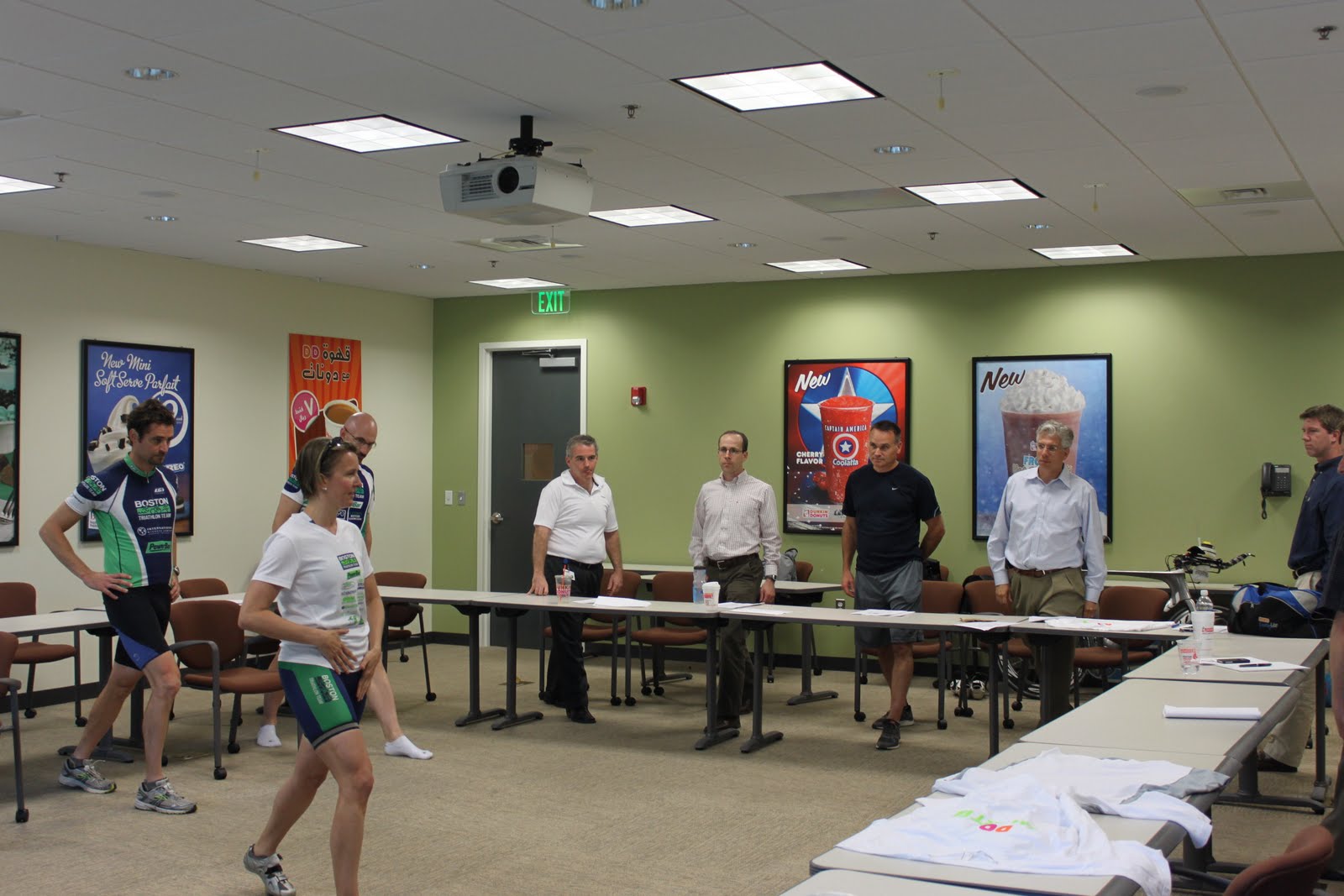
Last Thursday June 16,2011 the Boston Triathlon Team (BTT) and E3 Training Solutions had the opportunity to provide a cycling and nutritional training clinic for Dunkin' Donuts executives training for the Pan Mass Challenge through their new DDSMART menu.

DDSMART is their brand and corporate promise offering "better for you" menu alternatives and promoting an active lifestyle. All the products on Dunkin' Donuts menu with their DDSMART logo are options with reduced fat, calories, low in saturated fat, sugar, sodium, etc. In fact, when on the go and you need to refuel a whole grain bagel and egg whites could be a excellent option (carbs and protein!). You can check some of their options on their website through their nutrition catalog!

E3 coaches Brett Johnston and Jorge Martinez, plus BTT members Jess Douglas, Paul Newman and Tom Cristofili provided a casual clinic about cycling training, group ride etiquette, traffic laws, training and nutrition, race fueling.

Paul and Tom shared their experience as triathletes and gave important tips in terms of group riding and bike handling.

Brett (E3 coach in training) shared important information regarding common traffic laws, some of the challenges riders faced on the road and valuable safety tips in terms of what items are to important to bring on group rides.

Coach Jorge (USAT/USAC/E3L3) discussed the importance of endurance training, nutrition and fueling in general through training and racing. The talk included information about strategies to set up a fueling plan days before an important race, morning of a race, during a race and post-racing. It also included information about simple nutritional guidelines for endurance athletes, the role of glycogen in endurance racing and shared simple guideslines about exercise induced muscle cramping, side stitches and electrolytes.

Last but not least, Jessica shared her experiences as a Physical Therapist (MSPT, OCS) and athlete in terms of simple injury prevention tips and warm up/cool down strategies for cyclists.
After the clinic, the speakers and DD executives headed out for a quick10 mile ride to review some of the topics discussed through the clinic and to have fun!

This was a great experience and we look forward to provide more support to DDSMART. The Boston Triathlon Team is among those Boston teams in their partnership program with other teams such as the New England Patriots, Boston Bruins, Boston Red Sox, Boston Celtics and New England Revolution!

If you want to learn more about E3 Training Solutions or have a training clinic/talk organized for your company, please visit our website: www.e3ts.com or email us!

Racing Week Review

The success continues for E3 athletes, the Boston Triathlon Team and friends.

Analise Thompson kicked off her tri season with an age group win at the Sylvian Beach Triathlon and was the only female to break the 50 min barrier on the bike!
Andrew Thompson also had a strong showing finishing 4th AG and 9th overall but also he had a massive PR improving his bike speed by 4.5mph and run split by 40+ seconds min/mile when compared to last year race!
Jessica Douglas (coach in training) returned to racing posting a win on her 1st 5k comeback race!
Kris Kaplan had a solid day after facing some time off to post solid performances in the swim/bike at Eagleman 70.3, another step in the right direction for Timberman 70.3!

The Boston Triathlon Team
Jamie Strain won his age group at Eagleman 70.3 earning his Kona slot!

PBM Coaching
Mike Caiazzo ran his way to 6th place overall in the pro filed with one of the faster runs of the day!

Physfarm
Catriona Morrison continued her amazing year winning in the pro female field at the Tri Grand Prix Basque

Congratulations everyone!

To learn more about E3 Training Solutions programs click here

Racing Week Review

A busy and successful racing weekend for E3 athletes, the Boston Triathlon Team and friends.

  • Alaina Neary Case continued her successful year winning the Grand Rapids Half Ironman as the 1st female Overall. Husband Ryan Case also brought some hardware winning his AG and posting a major PR!
  • Jana Ritchtrova (czech chick) won her AG and finished 5th overall at the Rev3 Quassy Half Ironman
  • Brendan Hall continued his great season towards Ironman Lake Placid completing Mooseman 70.3 with a solid performance and a 12 min run PR!
  • Dan Arnett battled a snapped chain to successfully completed the Escape from Alcatraz tri!
  • Other Rev3 Quassy Half Ironman results
    • Noah Manacas kicked off his season with a solid performance and a great run!
    • Sean McCormick also posted a great performance and PR as preparation for Timberman
    • Michelle Quigley kicked off her season with a solid performance posting a great run.
    • Brian Quigley returned to racing tris and in spite of spotty tri training he had one of his best Tri performances!
    • Brett Johnston also began his tri season racing Rev3 as a stepping stone towards Ironman Cozumel and completing a successful day.
    • Jerry Maguire had a solid performance and more so, after joining E3 early in the year and successfully recovering from a Achilles tendinitis that plagued him for years. He ended up with 1 hr PR! Glad we were able to help him get back to racing and pain free.
The Boston Triathlon Team (and friends) produced great performances at Quassy Half and Olympic
  • Matt Pokress came back to placed 2nd on his AG and miss on 1st for a few seconds at the half
  • Brian Kearney finished 2nd on his AG coming back from a year off due to injuries
  • James Strain finished 3rd in his age group and 1st on the Aqua bike the next day!
  • Maggie O'Toole won 2rd AG!
  • Laurie Damianos, Karen Ghiron, Bethany Edwards, Maggi O' Toole,Trish Henwood and FoBTT Lucy Herzog and Grace Tsuei all completed successfuly the Olympic. Big shout out to Lucy for completing her 1st Olympic on a very tough course!
  • Matt Coarr, Keith and Michell Rousseau, Paul Newman, Joe Kurtz, Amy Robinson and Elaine Metcalf all successfully completed the Half, a very challenging course!
Amazing jobs everyone!

Racing Week Review

This past weekend was another successful racing weekend for E3 athletes and friends.

  • Alaina Neary Case case and her husband Ryan won 1st place overall in the Co-ed division at the American Triple T triathlon; a 3 day race with a sprint, 2 Olympics and 1 Half Ironman!
  • Dan Arnett had another great racing weekend placing 3rd AG at the South East Xterra Championship and earning his spot for the world championship in Maui, Hawaii.
  • Mathew Perry had a solid day at the Over the Mountain Oly Tri placing 4th AG missing the podium by a few seconds.
  • Not a race but many E3 athletes participated at the Boston Triathlon Team training weekend and all posted great training as preparation for coming races such as Rev3 Quassy, Mooseman and Patriotman.
As for our friends from ETA Coaching, Endurance Concepts and PBM Coaching, their athletes posted multiple wins, podiums and personal records! Some of the noteworthy were, Physfarm athlete and Pro Catriona Morrison won the female overall at Ironman Texas. 


Keep up the good work everyone!

Boston Tri Team & Powerbar run clinic

A few weeks ago the Boston Triathlon Team and Powerbar offered a run & nutritional clinic for athletes. I was one of the presenters were I discussed running technique and basic ways to improve it. For a short review about the clinic follow this link, in there you'll find more detailed information about my presentation. It has useful information about what biomechanics are, the components for performance, running economy, etc.

Enjoy!

Racing Week Review

It was a very busy racing weekend for E3 athletes and friends!

  • Brendan Hall started his tri season with an AG victory at the Devilman Half Lite
  • Brenda Chroniak continued her running season with a PR and AG win at the Mom's 5K
  • Sean McCormick kicked off his tri season with a 5th AG place at the Sudbury Sprint
  • Andrew Thompson got his feet wet on his 1st cycling road race, after a solo effort for most of the race he got caught at the end by the peloton. 
Boston Tri Team Members also had a great weekend posting victories or podiums at the New England Season Opener Duathlon and Devilman Lite. Congrats to Keith and Michelle Rousseau, Jaimie Strain, Regina and Magie O'Toole and Beth Edwards.

Some friends/athletes from the liver team participated on other local races, Michelle Dumas got back to racing post her 1st marathon (Boston) at the Melrose Run for Women with a solid performance. Other friends participated at the Tough Mudder up in VT for another type of endurance challenge.

Finally, a specially shout out for my Personal Best Multisport Coaching friends that swept the overall wins for both male/female and triathlon/duathlon at the Polar Sprint (Maine Worlds). Congratulations to Kurt Perham and his crew!

Performance Training Plans

We create a personalized training plan addressing your specific needs, time limitations and athletic goals for a particular race or for an entire season.

This option is a great alternative for athletes seeking structured training and coaching support without the full integration of our one-on-one programs.

This allows the athlete flexibility to tweak the structure in a personal way and get other services as need it.Our programs are evidence-based in basic physiology and proven training concepts that have produced remarkable performances from elite to recreational athletes.

Here you won’t find any marketing buzz, no magic ‘systems’ and no shortcuts. Our athletes succeed based on hard and consistent work.

Race Specific Plan:
$100 Account setup - $37.5 per 4/week personalized plan and coach support
or
Annual Membership (52 week commitment*):
Season program based on your main events and ongoing coach support - $145 per 4/week


Sign Up!


Race specific plans can be scheduled for 10 or more weeks targeting an specific race. The annual membership requires a 52 week commitment and the plan will be developed around all your target races up to 10 races (you receive 4 weeks free).


It includes:
1.       Initial Fitness Assessment
2.       Personalized training plan (every 4 weeks)
3.       Training history analysis to determine current level
4.       Functional Strength screening and personalized resistance training program
5.       Online training log hosted on Training Peaks (basic account) to track log your workouts and track progress.
6.       Field testing to develop sport specific training zones based on Heart Rate or Critical Power/Speed
7.       Access to E3 Training Solutions Training Guides.
8.       Enrollment to E3TS Team Club (for elite team you have to apply)
9.       Discounts with E3TS Sponsors and Supporters
10. E3TS Training T-shirt and water bottle

Coach Support: 
  • Unlimited Training log feedback. 
  • Email interaction with your coach; all questions/concerns will be responded within 24hrs during the week and 48hrs during the weekend 
  • Access to E3TS multi-media content including webinars, webcasts, podcasts, etc. 
  • Monthly conference call with your coach to address specific training questions (as needed)
Discounted Services:
20% off Performance Analysis (Gait/swim analysis and bike fit optimization)
15% off Clinical Run Gait Analysis
30% off Personalized Racing/Fueling execution plans
30% Personalized Nutrition Plans
50% Coached Group Training Sessions (i.e. track workouts, long runs, group rides etc.)

Sign Up!


* Annual Membership requires a 52 week commitment; the payment will be set up through automatic billing charged on credit/debit card as $145 every 28 days for 48 weeks and you get 4 weeks free


- If pay upfront you get a 5% discount off -